A business with owners in New York and a second company taking shape in Florida does not need two lawyers who have never spoken to each other. It needs one who is licensed to practice in both states and has done this work in both.
That is a narrower credential than it sounds. A lawyer admitted only in New York cannot pick up where the work crosses into Florida, and a lawyer admitted only in Florida cannot carry it back to New York. At Lawyer For Business, Andrea A. Willis is a Florida Bar and New York bar member in good standing, which is what lets her carry a matter from the New York filing through a Florida closing without a handoff.
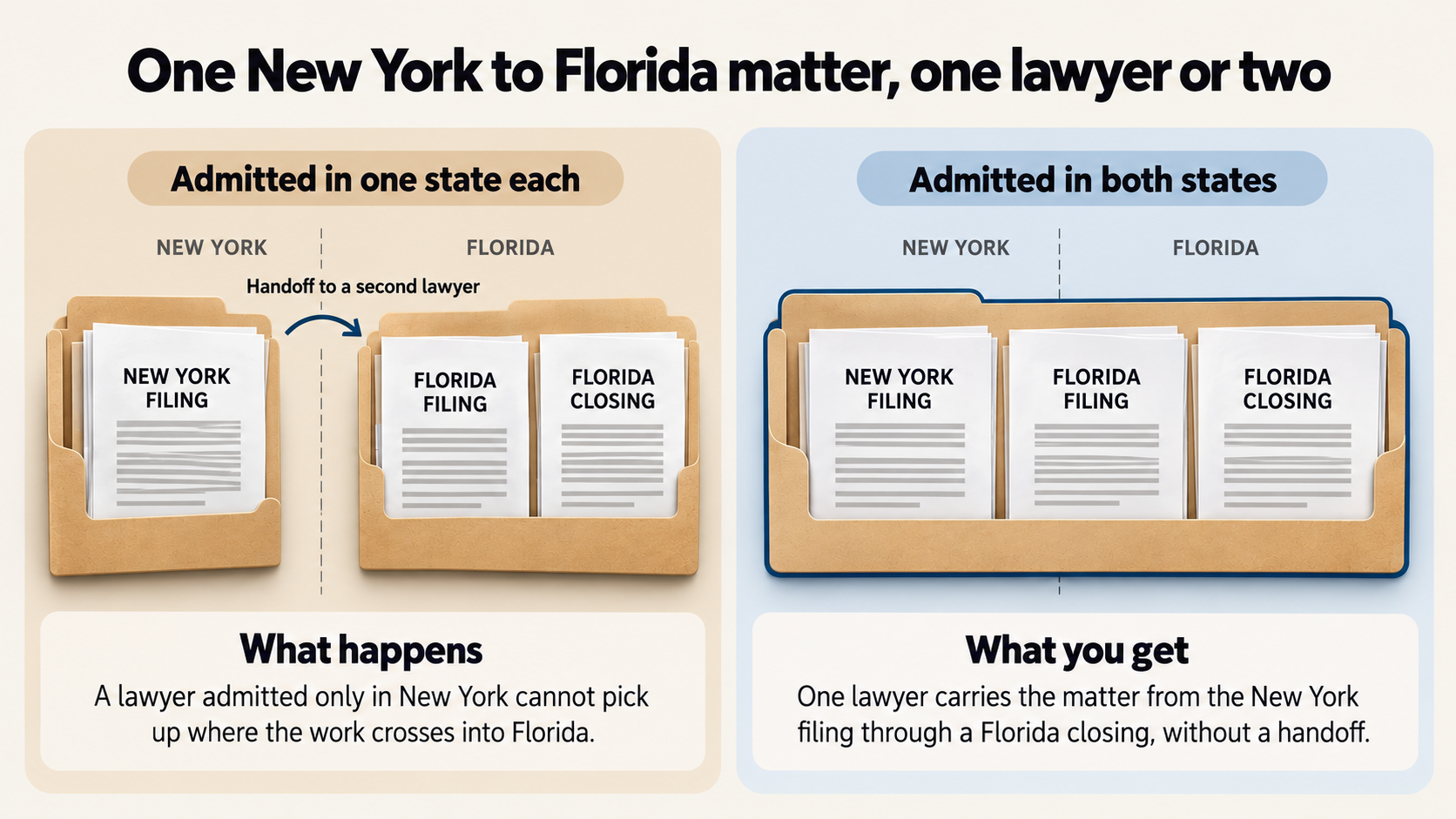
The work itself has a shape. It starts with a structure choice: an LLC in each state, or one LLC registered to do business in the other. From there it moves to each state’s own filings, to the contracts the business signs once it is operating in both places, and, for an owner buying rather than forming, to a Florida purchase. This page walks through each of those in order.
Owners who want the same company presence in New York and Florida have two real options, and each one starts a different clock.
| Option | New York side | Florida side | What follows |
|---|---|---|---|
| An LLC formed in each state | Meets its own New York filing and after-filing duties | Meets its own Florida filing and after-filing duties | Two separate companies, each kept current in the state where it was formed |
| Florida LLC registered in New York | Applies to the New York Department of State for authority under LLC Law § 802, with a Florida certificate of existence dated within one year, then publishes the application within 120 days | Already formed and in good standing | One company, authorized to do business in both states |
| New York LLC registered in Florida | Already formed and in good standing | Applies for a certificate of authority from Florida’s Department of State under § 605.0902, with a New York certificate of existence dated not more than 90 days before delivery | One company, authorized to do business in both states |
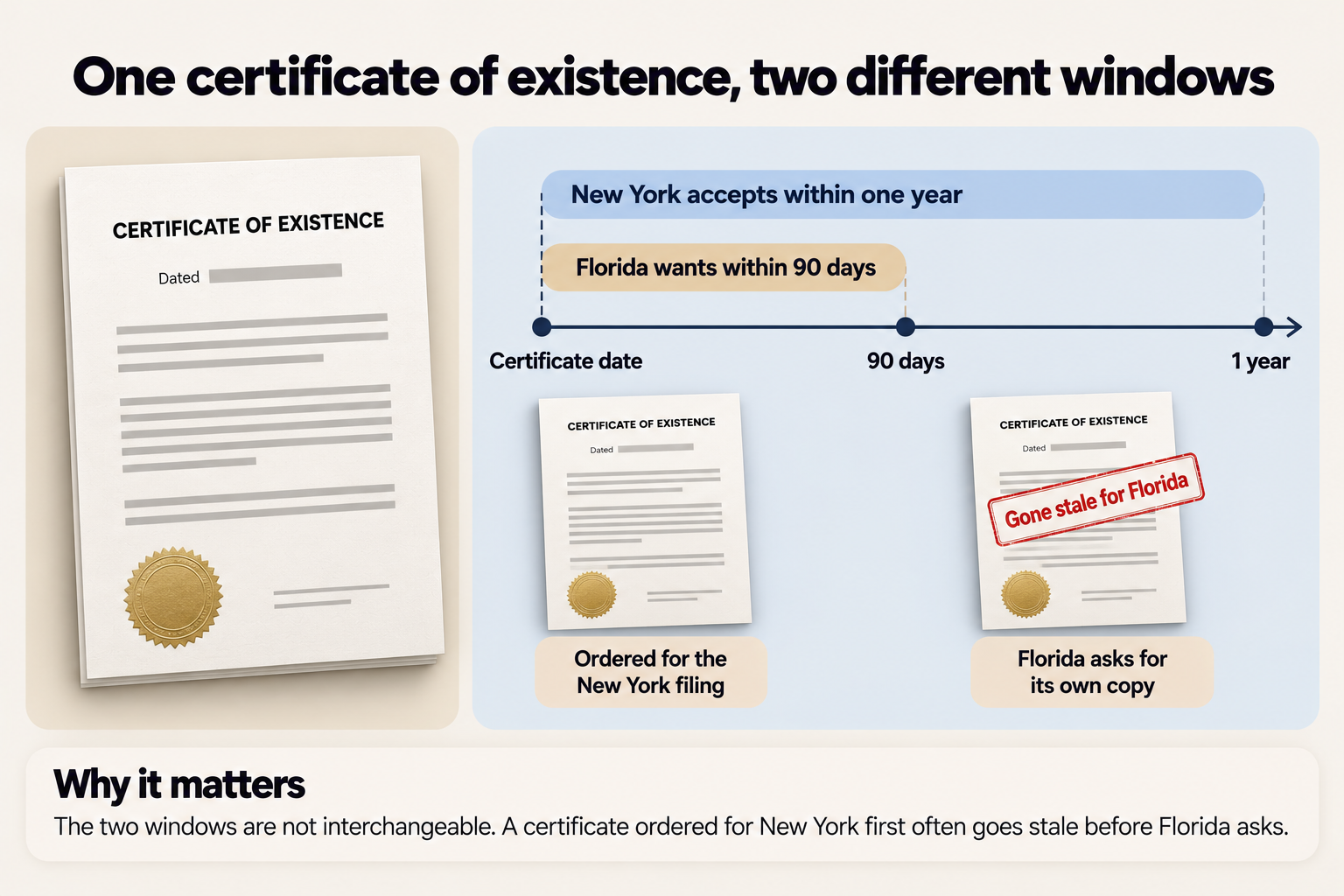
Notice that the two certificate-of-existence windows are not the same number. New York will accept one dated within a year; Florida wants one dated within 90 days, so an owner who orders the certificate for the New York filing first often finds it has gone stale by the time Florida asks for its own copy.
If you form a company separately in each state instead, each one still carries its own ongoing duties once the filing is accepted. New York’s is a domestic publication requirement, and Florida’s runs through the steps covered on what comes after you file with Sunbiz.
We find that the benefits of a parent-and-subsidiary structure, one company owning the other, usually outweigh its drawbacks in practice. It can also bring tax complications that a filing alone will not reveal, which is why we recommend working through the choice with an experienced business attorney and a tax advisor before you pick one.
Snowbirds, owners who spend part of the year in Florida and part in New York, usually assume that living part-time in a second state means hiring a second, local lawyer. It does not. A lawyer licensed in both states can advise on the New York company and the Florida side of the business remotely, by phone or video, from wherever you are at the time.
If you are a New York-licensed professional planning to move part of your practice to Florida, your entity structure may need to change along with your professional license and your state of residence. Florida has its own requirements for professional entities, and a structure built for a New York practice is not automatically the right one once Florida is in the picture.
Splitting time across two states raises two different kinds of questions, and they go to two different people.
Ask your lawyer:
Bring to your lawyer and your CPA together:
Once the entities exist, the next thing the owners sign is a contract, and a contract written for a business that operates in New York and Florida has to hold up in both places at once. Lawyer For Business reviews, drafts and negotiates the agreements that kind of business actually signs: employment, partnership, manufacturing, shareholder, licensing, confidentiality, operating, asset purchase and joint venture agreements, and commercial leases. Every contract we draft is written to be compliant with the state law it names, in New York and in Florida alike.
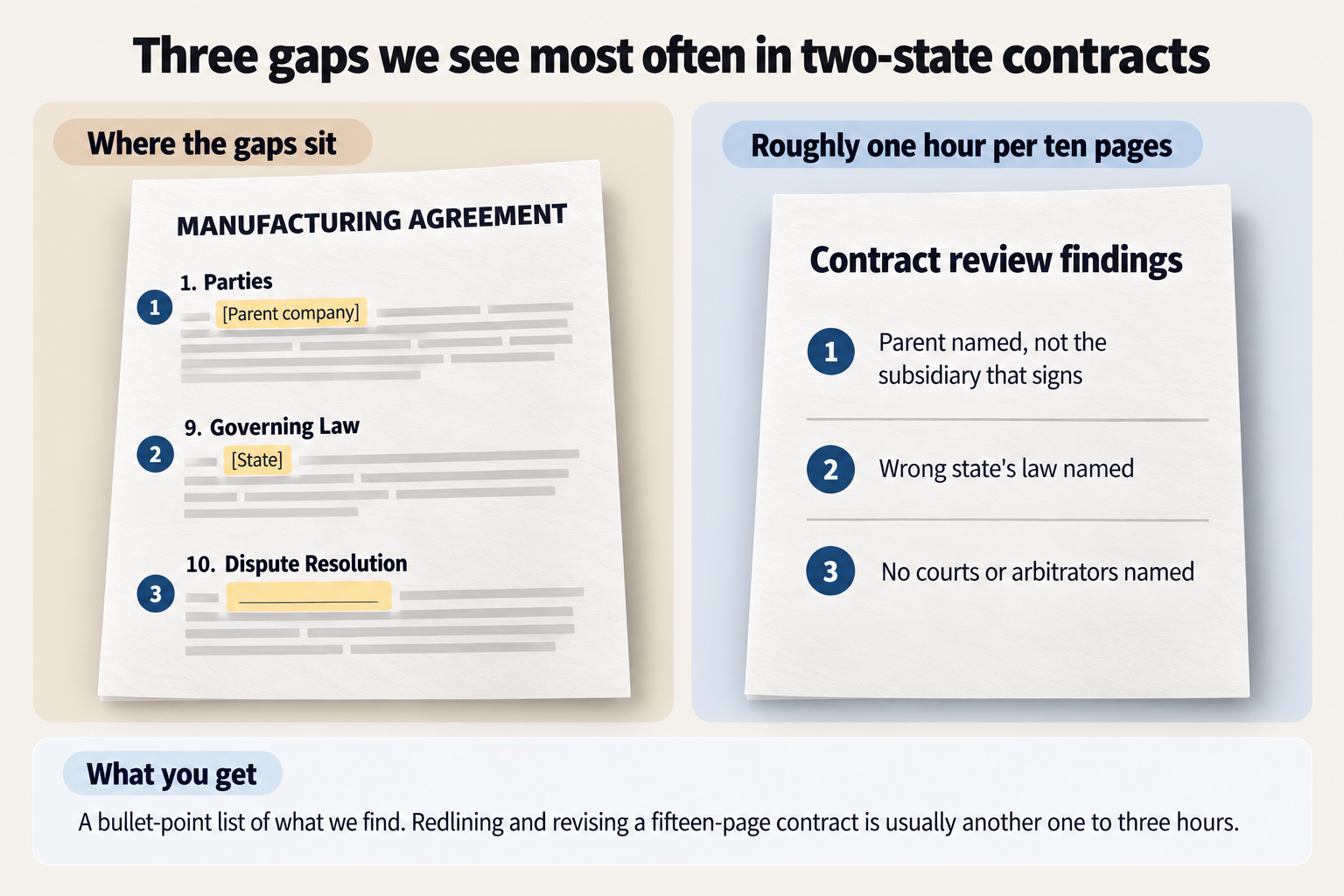
The gaps we see most often in a two-state contract are not exotic. The contract names the wrong entity, the parent company instead of the subsidiary that actually signs, or it points to the wrong state’s law to govern a dispute that will land in the other state’s courts. A dispute-resolution clause that never says which state’s courts or arbitrators hear the case leaves that question open for whichever side can afford to argue it first.
You should never sign a contract you do not fully understand, which is the plain argument for having someone read it before you do. Lawyer For Business reviews a contract at roughly one hour for every ten pages, producing a bullet-point list of what we find. Redlining and revising the document is usually another one to three hours for a fifteen-page contract, depending on the feedback and how many rounds of revision it takes.
Forming a company is one route into Florida. Buying an existing one is the other, and it comes with a timing problem most buyers discover too late.
If you’re buying an existing business in Melbourne or Viera, Florida, Andrea A. Willis and our firm can represent you from the letter of intent through closing. On the New York side, we draft and respond to letters of intent, prepare purchase agreements with seller-protective terms, structure indemnities, representations and warranties, and coordinate with the buyer’s counsel through closing. In Florida, we represent both buyers and sellers, reviewing the asset-versus-equity structure, running due diligence on contracts, leases and licenses, and drafting the purchase agreement itself.
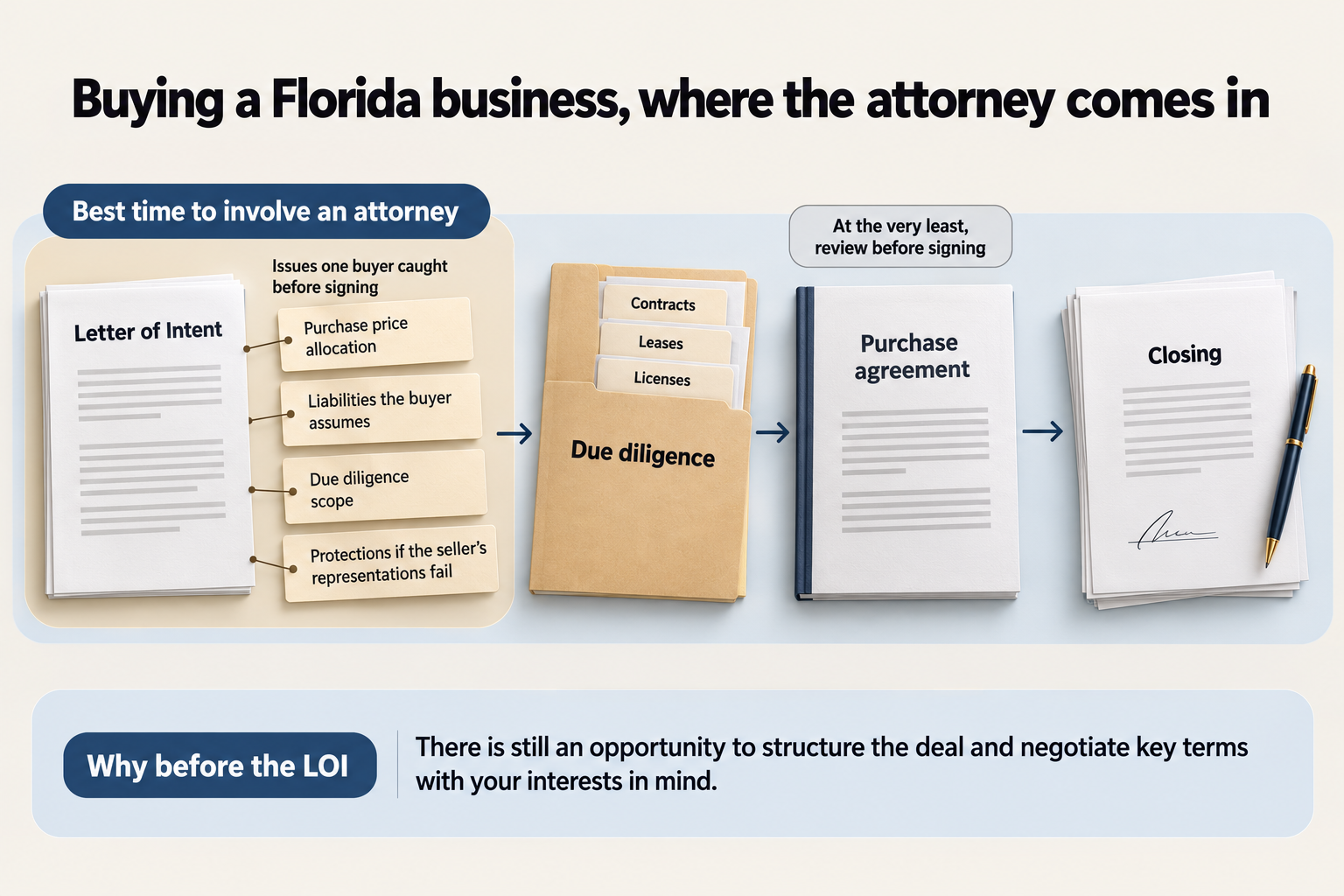
The best time to involve a business attorney is before you sign the Letter of Intent, when there is still an opportunity to structure the deal and negotiate key terms with your interests in mind. At the very least, you should have an attorney review the transaction before you sign the definitive purchase agreement. Consultations are fully virtual, conducted by phone or video, so you can handle the entire matter from Buffalo without setting foot in a Florida office.
“For more than a decade, I’ve helped buyers negotiate Letters of Intent for business acquisitions in New York and Florida.
For example, I recently worked with a buyer who was acquiring an established business. We identified issues in the proposed deal structure before the buyer signed the LOI, including how the purchase price would be allocated, what liabilities the buyer would assume, the scope of the due diligence period, and the protections the buyer would have if the seller’s representations did not hold up.
I also work alongside your outside accountant and financial advisors when tax, valuation, or financial questions arise during due diligence. The goal is not simply to get your deal signed. It is to help you understand what you are buying, identify risks before they become expensive problems, and structure the transaction so you are protected from the outset.”
At Lawyer For Business, our fees for a business purchase or sale depend on the matter and are discussed at your consultation, because an asset purchase and a full equity sale are not the same amount of work.
| Service | New York | Florida | How the fee is set |
|---|---|---|---|
| LLC formation package | $2,569.82, includes filing fees and ads (as of October 1, 2026) | $931, includes filing fees (as of October 1, 2026) | Flat. We only do flat fees for legal entity formations |
| Business consultation | 45 minutes, $350 (as of October 1, 2026) | $350 plus nominal credit card processing fees, as of October 1, 2026 | Flat, per session |
| Contract review | Time-based, see above | Time-based, see above | Time-based, see above |
| Business purchase or sale | Discussed at consultation | Discussed at consultation | Depends on the matter |
Included filing costs: a $200 Articles of Organization filing fee, a $10 certified copy, $50 for expedited processing, and a $50 Certificate of Publication.
Included costs: a $125 Articles of Organization filing fee, a $30 certified copy, and all legal fees for drafting and forming your LLC.
We can also help you register your business in a new state and guide you through the process of handling all forms of interstate legal matters. For a New York LLC or PLLC, you are legally in business within 24 to 48 hours after we receive your signed retainer agreement and payment, and for New York’s publication step, the cost varies by county, with the average cost already built into the flat fee above. For a New York LLC, we can also help you locate a suitable registered agent.
For matters outside business transactional law, litigation, most often, we work with a team of co-counsel, so a dispute does not have to go to a different firm from scratch. We proudly serve businesses across New York and Florida, and the first step on either side is the same.
Book a business consultation for your state, or start with our LLC formation service if the structure question above already pointed you to an answer.
Can a New York attorney practice in Florida?
Not as a regular Florida practice. Under Rule 4-5.5 of the Rules Regulating The Florida Bar, a lawyer not admitted in Florida may not establish an office or other regular presence there for the practice of law, or hold out to the public as admitted to practice in Florida.
The rule does allow limited, temporary services by out-of-state lawyers in specific circumstances. Whether a particular arrangement fits that exception depends on the facts, which is a question for the lawyer’s own bar status in each state rather than something this page can answer for you.
Can an attorney be a registered agent for an LLC?
Yes, but our firm does not offer this service, given the large volume of clients we would need to accept service on behalf of. Instead, we have third party companies we are happy to refer you to in both New York and Florida.
Do I need a lawyer to start an LLC in Florida?
Skipping a lawyer when filing an LLC is a risk worth avoiding. Many business owners who handle the filing themselves end up paying more later to fix mistakes the filing never caught, and we built our formation package around attorney oversight so that cost doesn’t show up afterward.
We recommend against building a two-state company on an online form or a generic checklist, since the structure choice covered above is exactly the kind of decision a template cannot make for you.
The information you obtain on this page is not, nor is it intended to be, legal advice. Contacting us does not create an attorney-client relationship, and you should not send confidential information to us until an attorney-client relationship has been established.