Franchisors like to call their paperwork standard, but it’s worth asking whom that standard serves. You picked a brand and found a location. Now a stack of documents labeled a franchise disclosure document, or FDD, has landed in your inbox along with a franchise agreement you’re told not to worry about.
You should worry about it before you sign, not after you’ve already signed. One of those documents is required by federal law. The other is the contract that binds you for the next five or ten years, and only one kind of lawyer reads them as a pair.
That lawyer is a business lawyer acting for you, the buyer, not the franchisor, who reviews the franchise disclosure document and the franchise agreement together before you sign anything or pay anyone. At Lawyer For Business, that review is billed hourly and is custom to each set of documents. It can start at about 6 or more hours for a 250-page FDD, or about 4 to 6 hours for 150 pages, covering the review itself and a bullet-point list of concerns.
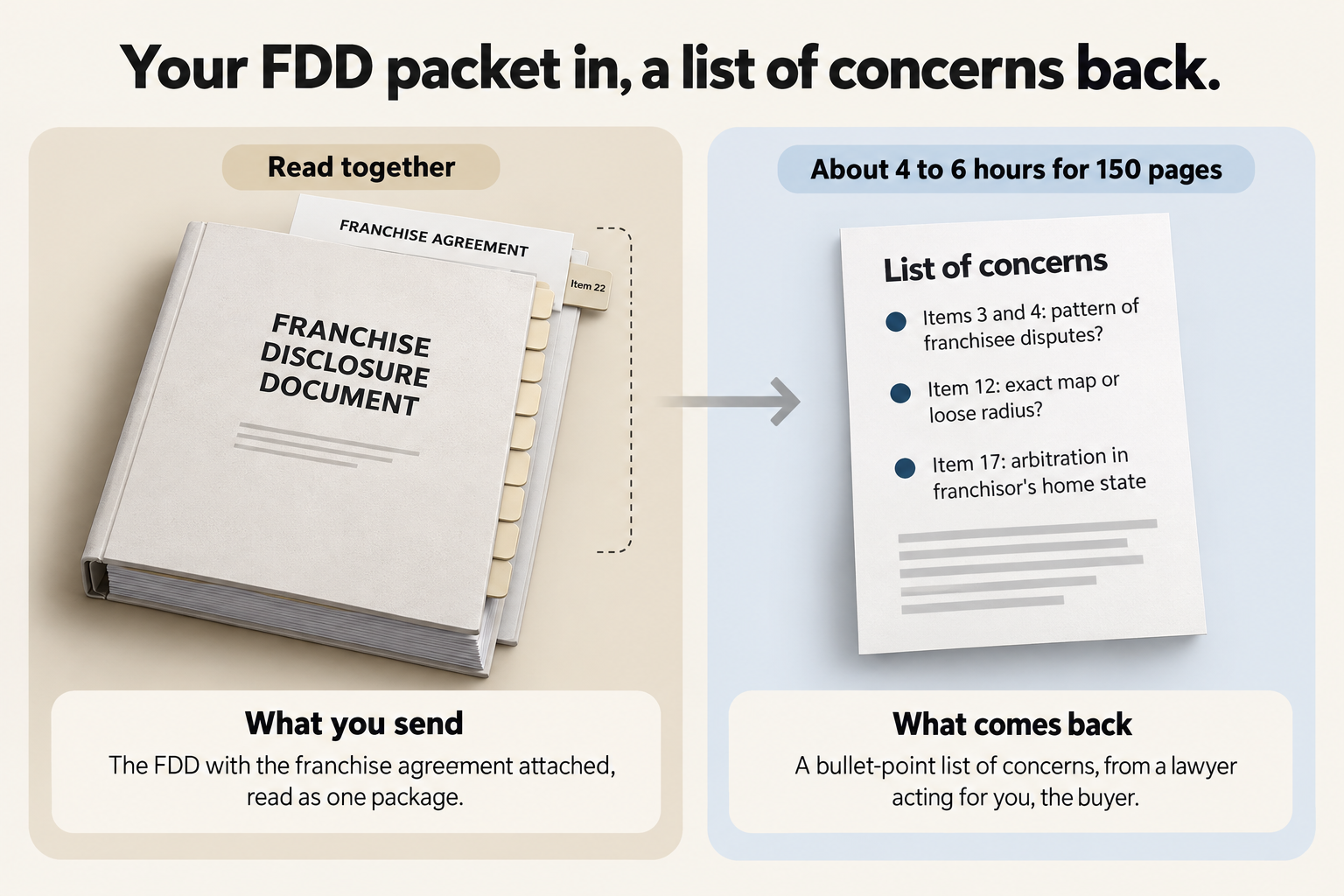 You send the FDD and franchise agreement as one package, and a lawyer acting for you sends back a list of concerns.
What follows is what that review checks, Item by Item: what the federal disclosure rule does and doesn’t require, whether the “non-negotiable” agreement really is, and what changes the hours a review takes.
Franchise agreements are written for the franchisor, and they’re often heavily one-sided. Franchisees end up stuck in bad deals because they trusted the franchisor to look out for their interests, when only a lawyer representing the buyer does that.
A bio that says “franchise attorney” matters less than you’d expect. Experience handling business deals generally, and reading contracts for what they commit you to, counts for more than the practice-area label on a website.
A franchisor is unlikely to volunteer this on its own. According to the FTC’s consumer guide to buying a franchise, royalties are typically owed for the right to use the franchisor’s name even when the location is losing money. That obligation can run for the full term of the agreement.
A lawyer who reads the agreement before you sign is the one who tells you that going in, not after your first bad quarter.
The timing here is federal, not a state rule, and it’s the same whether you’re buying in Ohio or Oregon. Under the FTC’s Franchise Rule, the franchisor must give you its current disclosure document at least 14 calendar days before you sign a binding agreement with it, or pay it or an affiliate anything.
Some buyers get ahead of that clock with a letter of intent, negotiated before the FDD even arrives. A carefully built LOI clarifies deal terms early, so there are fewer surprises once the full disclosure document lands on your desk.
The FDD’s cover page carries a required notice: there may also be laws on franchising specific to your state, and you should check with your state’s agencies about them. This page covers the federal layer only, which is the same nationwide.
In practice, the sequence runs:
The FDD contains the regulation’s required 23 disclosure items, but they don’t carry equal weight. Some are boilerplate. A handful are where the actual risk sits, and this is the map a buyer-side review starts from.
The table below shows what each item discloses and what a buyer-side review looks for in it:
| FDD Item | What it discloses | What a buyer-side review looks for |
|---|---|---|
| Items 3 and 4 | Litigation and bankruptcy history | Whether the franchisor or its executives have a pattern of disputes with franchisees |
| Item 7 | Estimated initial investment | Whether the franchise fee is the whole cost, or whether build-out and grand-opening costs push the real number higher, by adding each line item’s high estimate rather than stopping at the franchise fee row |
| Item 8 | Restrictions on sources of products and services | Mandatory vendors, you’ll be required to buy from |
| Item 12 | Territory | How much protection you have against the franchisor opening another location or selling online inside your territory, and whether that boundary is an exact map or a radius loose enough for the franchisor to encroach |
| Item 17 | Renewal, termination, transfer, and dispute resolution | Transfer approval and fees, termination rights and fees, and whether disputes are arbitrated in the franchisor’s home state, since that can mean traveling there to contest even a small dispute |
| Item 19 | Financial performance representations | Whether the franchisor backs up its revenue or profit claims with data, or avoids making them at all, and if it does, how many outlets those figures are drawn from |
| Item 20 | Outlets and franchisee information | Franchisee turnover, since a high rate across the system is worth asking about directly |
| Item 21 | Financial statements | Reviewed alongside your accountant, since this item speaks to the franchisor’s financial health rather than deal terms |
| Item 22 | Contracts | The attached agreements themselves, including personal guaranties that put personal assets at risk and non-compete terms that can outlast the franchise itself |
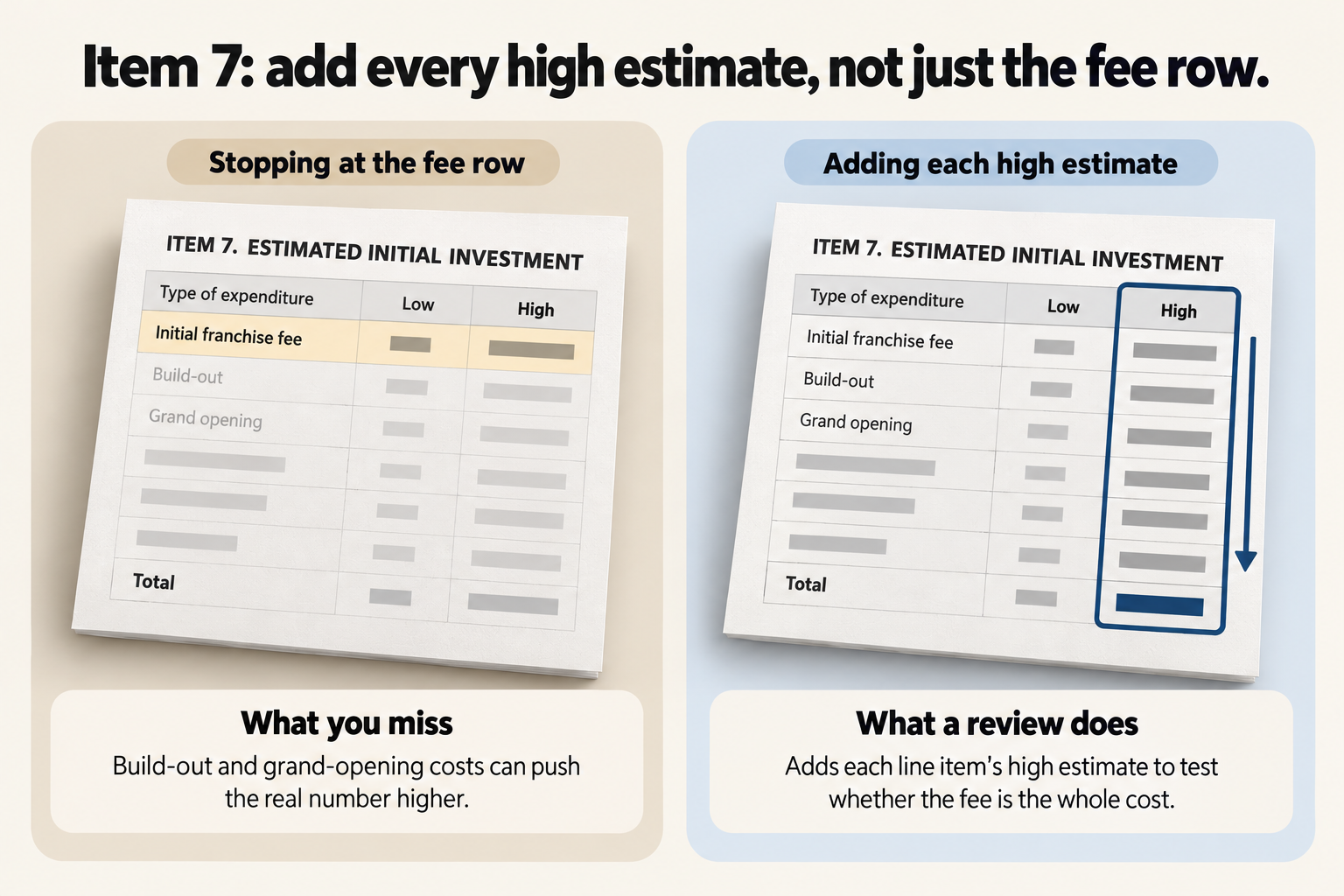 In Item 7, a review adds each line item’s high estimate to test whether the franchise fee is the whole cost.
Two checks sit outside the FDD itself, and they’re just as important:
The franchisor’s rep will tell you the agreement is standard, and the terms aren’t open for discussion. That’s rarely entirely true.
Territory exclusivity, ramp-up timelines, and fee schedules can sometimes be adjusted for first-time franchisees who ask, depending on the brand, the market, and your leverage as a buyer. Always ask before assuming a term is final. Our negotiation guidance for franchise buyers walks through where that leverage tends to sit.
Only the franchisor’s own unilateral, material changes to the attached agreements trigger a new waiting period, at least 7 calendar days before you sign. Changes that come out of negotiation you initiated don’t reset that clock, so asking for something and getting it doesn’t buy the franchisor extra delay.
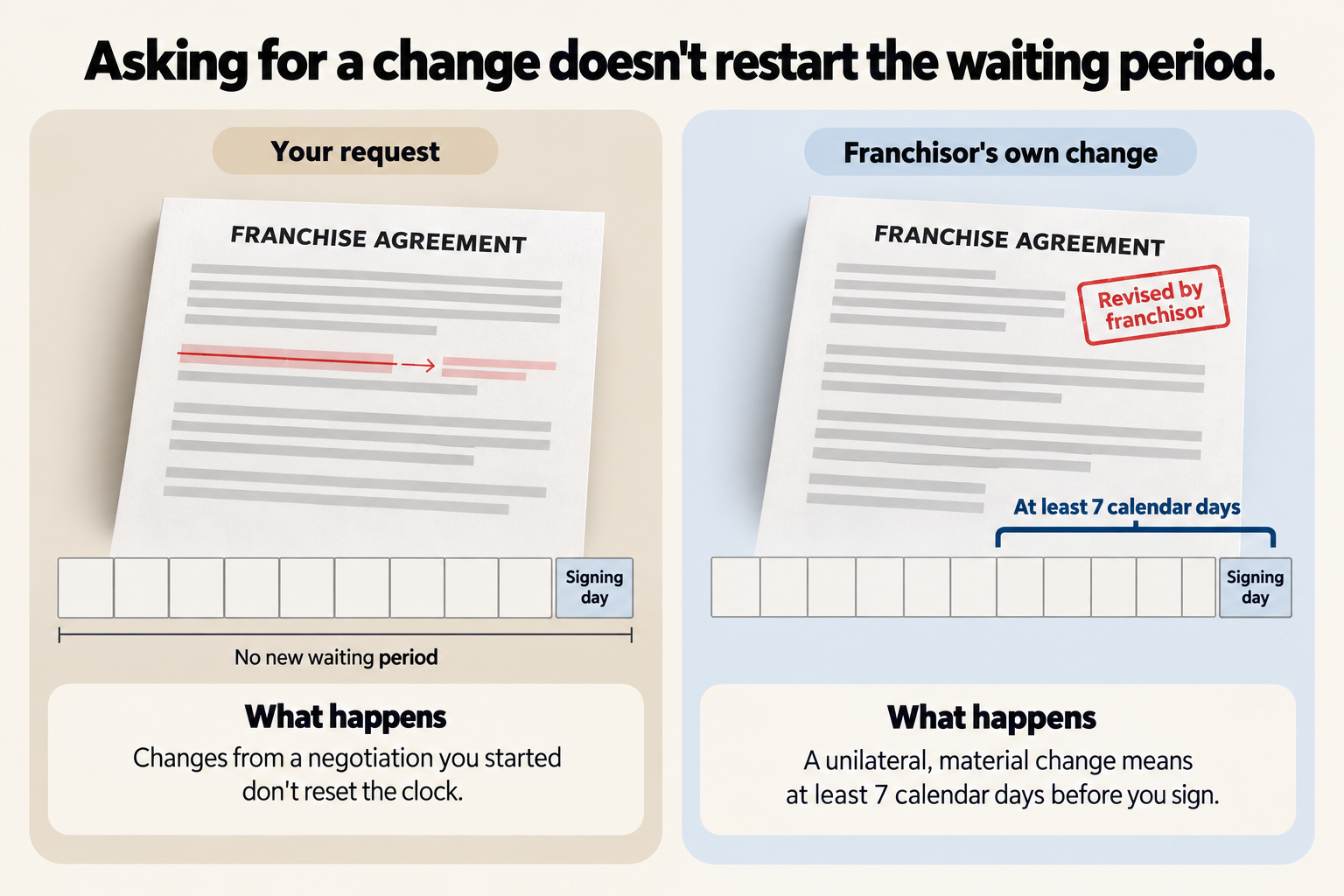 Only the franchisor’s own unilateral, material change triggers a new waiting period of at least 7 calendar days.
This result isn’t typical, and most negotiations won’t move this far. It shows the range of what’s possible when a franchisor calls its documents final. Our firm negotiated the terms of an “unmodifiable” set of franchise documents for a client, saving them fifty percent off the purchase price, a result we’ve published. We also removed language that was detrimental to the client’s long-term success and modified the personal guaranty so it could be lifted after the satisfactory completion of an earnout period.
What drives the hours is the document itself: its length, its complexity, and how many exhibits are attached to the FDD, and cost varies from provider to provider from there.
Here’s how that time breaks down once you’re past the initial review:
| Work | What it involves | How Lawyer For Business handles the time |
|---|---|---|
| Review and issues list | Reading the FDD and franchise agreement together and producing a bullet-point list of concerns | Billed hourly, and the time follows the document’s length, complexity, and exhibits. |
| Redlining the agreement | Drafting changes into the agreement itself, beyond flagging concerns | Additional time, billed at the firm’s hourly rate |
| Calls, emails, and follow-up | Everything outside the drafting itself | Billed at the same hourly rate as the review, since hourly billing doesn’t distinguish a phone call from a redline |
If you’re comparing legal work quotes, compare the scope, not just the number. A quote for review alone and a quote for review plus negotiation are different jobs, even when the figures on each look similar.
Before you compare numbers, check what each quote covers:
A quote that’s silent on more than one of these is hard to compare against anything but its own total.
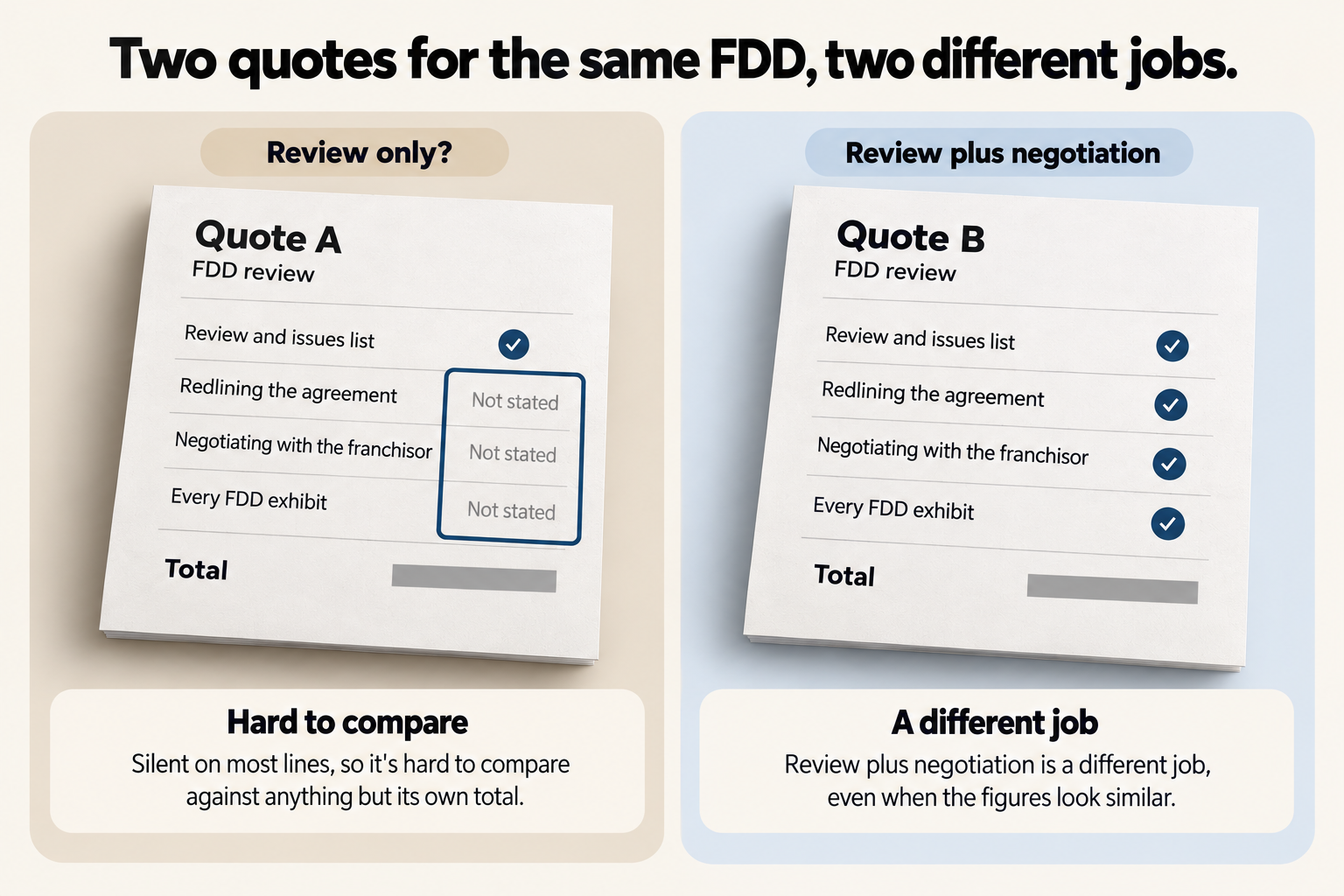 A quote for review alone and a quote for review plus negotiation are different jobs, even when the figures look similar.
Franchise buyer representation at Lawyer For Business covers the full arc, not just a single document. Our franchisee services include:
Before we recommend you sign anything, the work runs through five steps:
I’ve represented buyers purchasing everything from established local businesses and professional practices to franchises and service companies. In one recent transaction, I helped a buyer evaluate the deal, identify issues that could have created significant problems after closing, and negotiate protections before they committed to the purchase. My job is not simply to get you to closing.
Andrea A. Willis
Franchise law is national, and we represent buyers anywhere in the United States, working remotely from the first document review through signing, as outlined on our franchise practice page.
If you’re buying in New York or Florida, that same engagement can extend into the lease and contracts that follow the franchise agreement. Andrea A. Willis is a Florida Bar and New York Bar member in good standing.
On the financial side, we work with your accountant or CPA to address the tax considerations that come up throughout a franchise purchase.
Consultations are fully virtual, conducted by phone call or video call, and you can handle the entire matter online without setting foot in an office.
The process starts with a 45-minute business consultation. In New York, it costs $350. In Florida it’s $350 plus nominal credit card processing fees, both as of October 1, 2026. Book a consultation for your state before you sign anything.
At Lawyer For Business, the franchise agreement is usually included inside the FDD packet itself, so its review falls inside the FDD review time already described rather than being priced as a separate job.
Redlining the agreement, meaning drafting your requested changes directly into it, is additional time beyond that initial review.
The franchisor furnishes the FDD directly, once you’ve reached that stage of the sales process.
Federal law counts delivery as complete by hand, fax, email, through internet directions to the document, or by first-class mail sent at least 3 calendar days before your 14-day deadline. Ask for it as soon as you’ve settled on a brand, since the earlier it arrives, the more time your lawyer has before you’re expected to sign.
Cost varies by provider, and an FDD isn’t priced the same way an ordinary contract is.
At Lawyer For Business, an FDD review is billed hourly and can start at about 6 or more hours for a 250-page FDD, or about 4 to 6 hours for 150 pages, so the useful comparison between quotes is scope, not just the number.
Reviewing an ordinary contract generally runs about an hour for every 10 pages to produce a bullet-point list of concerns. Redlining usually adds another 1 to 3 hours for a 15-page document.
An FDD review is estimated separately, based on the document’s length, complexity, and exhibits, as described above.
The information you obtain at this site is not, nor is it intended to be, legal advice. Contacting us does not create an attorney-client relationship. Please do not send any confidential information to us until an attorney-client relationship has been established.