A professional limited liability company sounds like an ordinary LLC with one extra letter. It isn’t quite that, and the difference is worth settling before you file rather than after.
In Florida, a PLLC is a limited liability company, formed under the same Chapter 605 that covers every Florida LLC, that also meets Chapter 621. Under Chapter 621, individuals, professional corporations and PLLCs who are licensed to render the same professional service can form an LLC for that one specific service. That’s the specific distinction Chapter 621 draws. File the wrong one, or bring on the wrong co-owner, and you are either redoing the paperwork or rewriting who owns the practice, usually after it’s already running.
This page covers what changes under Chapter 621, who can own a Florida PLLC, and what it protects you from. It also covers what the Division of Corporations charges to file one, and what changes if you’re relocating a New York practice south.
Four things separate the two, and the table below lines them up side by side.
| Feature | Florida LLC | Florida PLLC |
|---|---|---|
| Purpose | Any lawful purpose | One specific professional service |
| Name ending | “Limited Liability Company,” “LLC” or “L.L.C.” | “Chartered,” “Professional Limited Liability Company,” “P.L.L.C.” or “PLLC” |
| Owners | Not addressed by Chapter 621 | Limited to licensed professionals, covered below |
| Personal liability | Not addressed by Chapter 621 | Narrowed by Chapter 621, covered below |
| Federal tax default | Disregarded entity if one owner, partnership if more than one, unless the LLC elects otherwise | Same default |
The purpose row is where most of the confusion starts: a plain Florida LLC can pursue any lawful purpose, while a PLLC can only render the one professional service it was organized to provide.
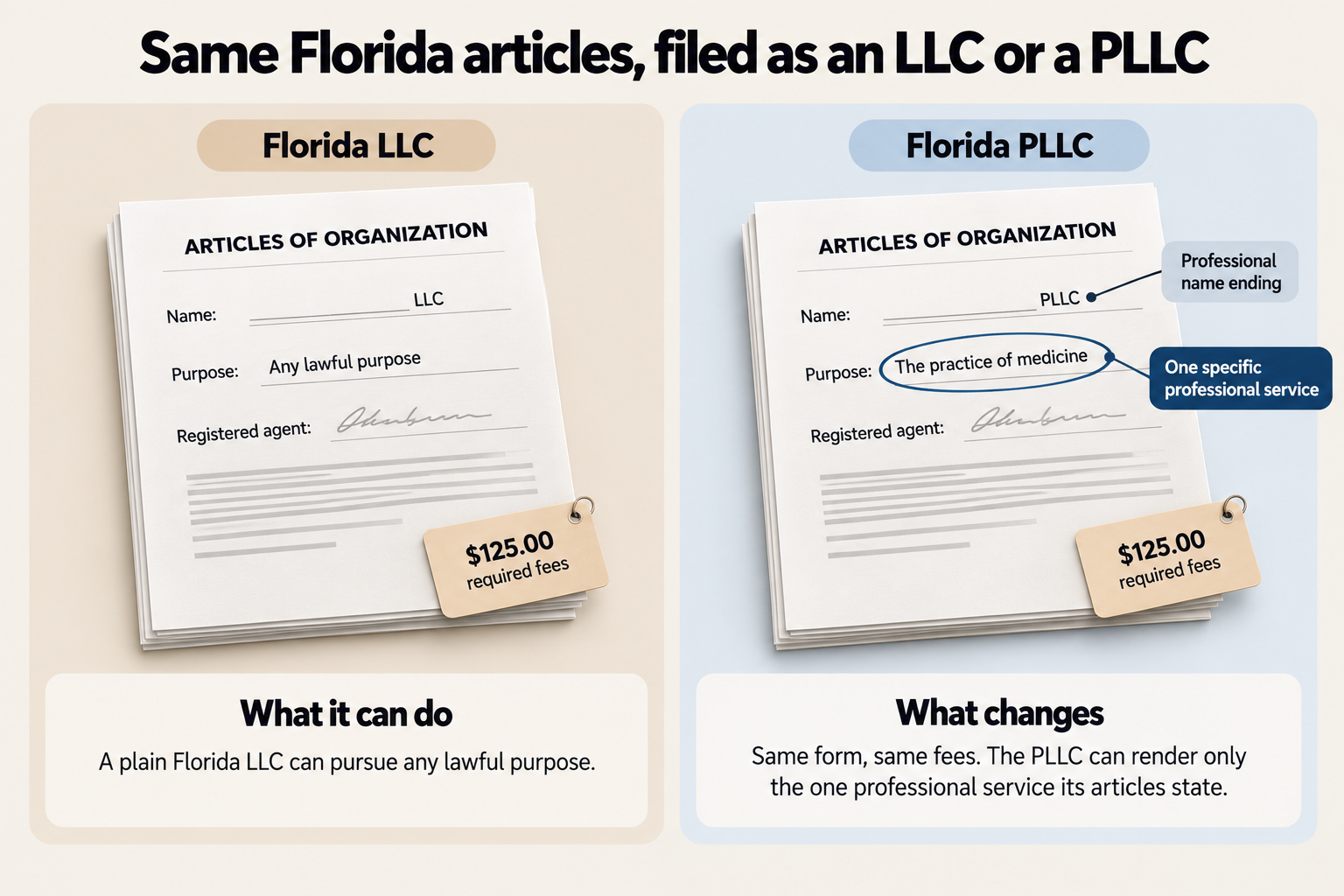 Same form and same fees, so look at the purpose line, where the PLLC names its one professional service.
What the table doesn’t settle is whether you’re required to deal with Chapter 621’s constraints at all, or whether a plain LLC is an option for your license.
Chapter 621 answers a narrower question than most readers expect. Once a company is organized under Chapter 621, it can render professional services only through officers, members, employees and agents who are themselves licensed or legally authorized to render that service. Support staff, clerks, bookkeepers and technicians are the one exception.
That rule governs companies organized under Chapter 621. It doesn’t say, on its own, whether your profession’s licensing statute requires you to organize that way in the first place, or would let you operate as a plain LLC instead. Florida’s professional licensing statutes and each board’s own rules answer that question, profession by profession, and no single source settles it for every license type.
Before you file, confirm with your licensing board:
Whichever entity your board calls for, if it’s a PLLC, the next constraint is who’s allowed to own a piece of it.
Chapter 621 states the ownership rule precisely. A PLLC’s membership is limited to an individual, a professional corporation, or another PLLC, each licensed or legally authorized to render that same specific professional service. That is the complete rule.
A physician who wants to add a spouse who manages the office, or an investor who isn’t licensed, as a member runs into this directly. Neither qualifies, because neither is licensed to render the practice’s professional service.
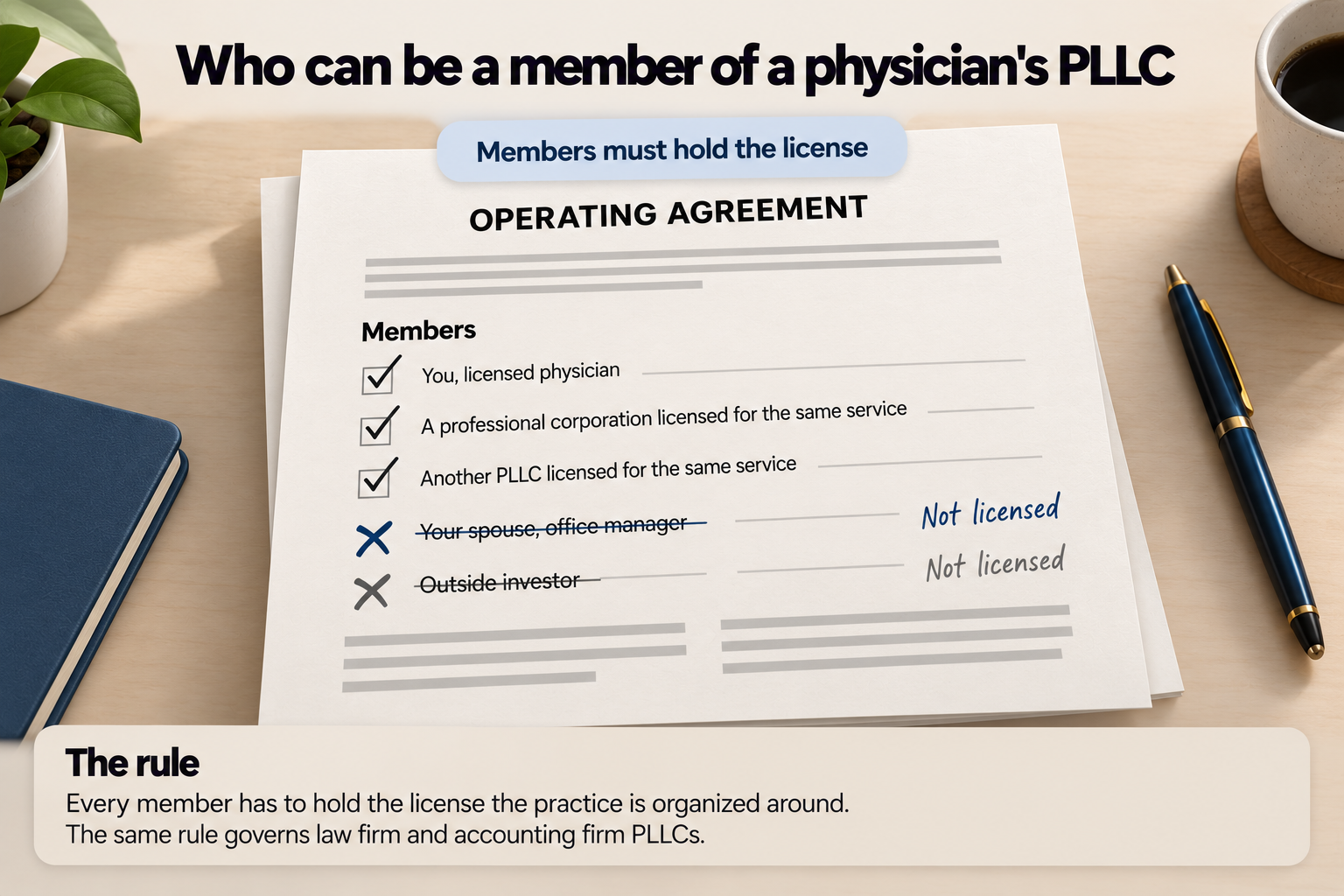 The spouse who manages the office and the investor come off the list, because neither holds the license.
The same rule governs a physician group PLLC as it governs a law firm or an accounting firm PLLC. Every member has to hold the license the practice is organized around:
Settling who can own the company still leaves open what owning it protects you from.
Forming a PLLC does not erase your personal liability for your own professional work. That’s the assumption readers most often get wrong.
You remain personally liable for your own negligent or wrongful acts, and for the acts of anyone working under your direct supervision and control while rendering professional services. That liability follows you whether or not you’ve formed a PLLC. A malpractice claim against your own work reaches you personally, PLLC or not.
The company itself is liable up to the full value of its property. That shield protects you from a colleague’s debts, and from a colleague’s malpractice when you weren’t the one supervising them.
A PLLC changes whose mistakes reach you, but it does not change whether your own mistakes do.
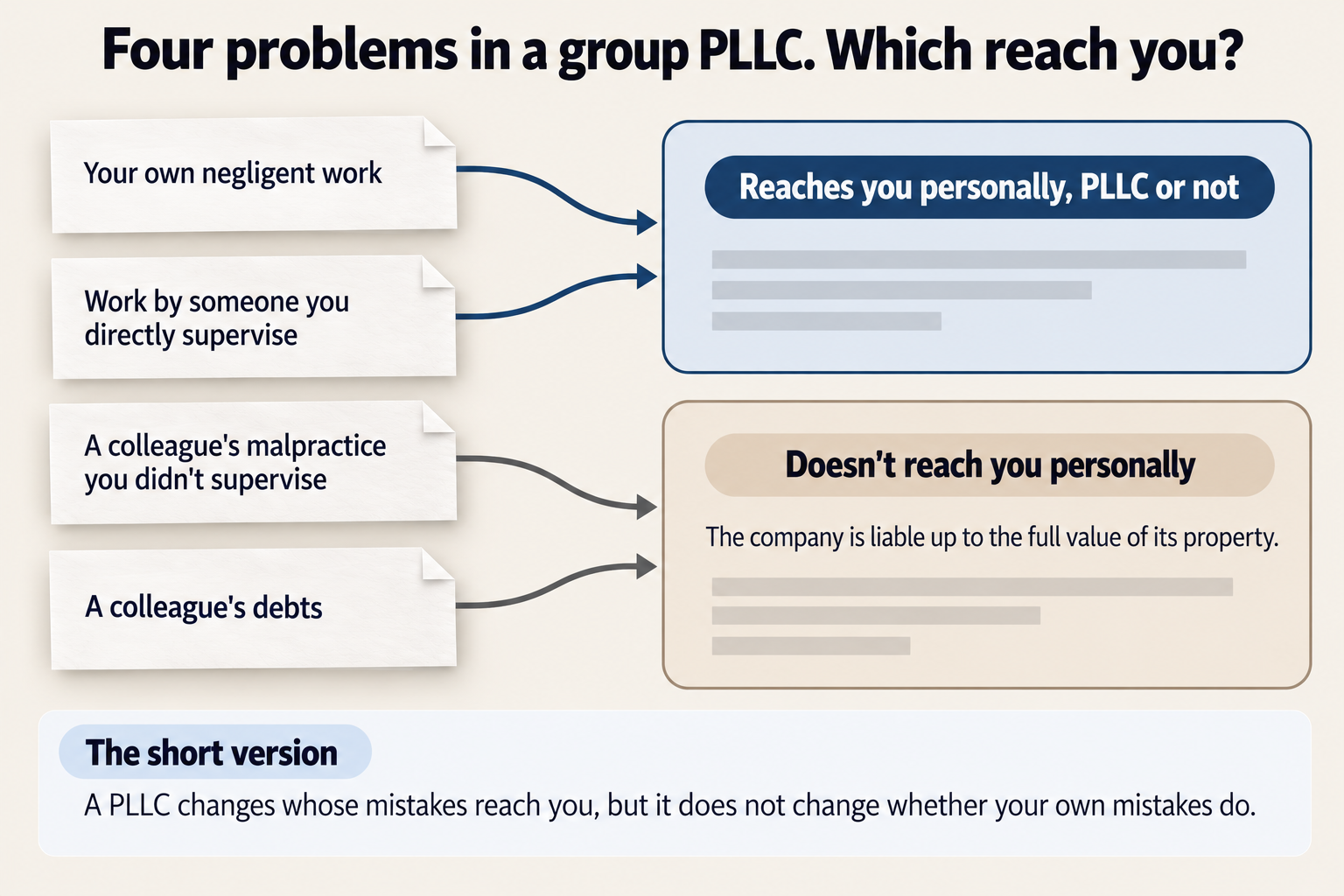 Work you directly supervise lands in the same pile as your own negligent work.
A PLLC is filed on the same form as any other Florida LLC, though the articles just have to say more.
| Division fee item | Amount as of October 2026 | Required or optional |
|---|---|---|
| Articles of Organization | $100.00 | Required |
| Registered Agent Designation | $25.00 | Required |
| Certified copy | $30.00 | Optional |
| Certificate of status | $5.00 | Optional |
The two required items total $125.00. There’s no separate fee schedule for a PLLC. It files on the same LLC articles and pays the same LLC fees as any other Florida LLC, with the professional purpose written into the form.
Filing those articles correctly, with the professional purpose stated the way the Division expects, is the kind of task our Florida business formation attorneys handle for clients who would rather not redo a rejected filing.
A Florida PLLC and a New York PLLC aren’t interchangeable, even if you’ve held the New York one for years. Your entity structure may need to change along with your professional license and your state of residence, because Florida’s requirements for professional entities, licensing, taxation and formation differ from New York’s.
Andrea A. Willis is a Florida Bar and New York Bar member in good standing, which matters here. A professional moving a licensed practice between the two states is working within two different statutory schemes, which involves more than a simple change of address.
Our comparison of New York’s LLC and PLLC rules covers the New York side of that move.
Forming a Florida PLLC yourself is possible, since the Division’s articles are a public form. What the form doesn’t tell you is whether your profession requires a PLLC in the first place. It also won’t tell you who may hold an ownership interest once a spouse or an office manager gets involved. Nor will it tell you how to write an operating agreement that matches Chapter 621’s restrictions rather than a generic template’s.
We help clients launch LLCs, PLLCs, corporations and partnerships, filing with Florida’s Division of Corporations and handling the compliance work that follows. For licensed professionals specifically, we provide PLLC formation and related legal services to physician groups, law firms, accounting firms and other licensed practices.
We also draft custom operating agreements for Florida LLCs and PLLCs that reflect Chapter 621’s ownership and voting restrictions, rather than leaving a template to guess at them. Many owners who form and staff a professional practice on their own end up paying more later to fix a mistake than they would have spent getting the structure right at filing.
Andrea A. Willis, the firm’s founding attorney, puts it this way:
I regularly review AI-generated operating agreements, ChatGPT legal documents, and online LLC templates for business owners who assumed their agreements were solid… Some of the worst partnership disputes and LLC lawsuits I see begin with an operating agreement that appeared “good enough” when the company was formed.
I have seen six-figure businesses collapse because a generic AI operating agreement or online template failed to properly address ownership exits, distributions, voting authority, or transfer restrictions… Many business disputes are entirely predictable years before they happen.
We offer a 45-minute Florida Business Consultation for $350, plus nominal credit card processing fees, as of October 1, 2026. During the consultation, we discuss your specific situation and give you a transparent estimate of what your PLLC formation and operating agreement will cost. Consultations are fully virtual, by phone or video, and we handle Florida PLLC formation remotely throughout Brevard County and the rest of the state, so you never have to set foot in an office.
Book your Florida Business Consultation.
Yes. In Florida, a PLLC is organized under the same Chapter 605 that governs every LLC, and Chapter 621 controls only where the two chapters conflict.
That means most of what applies to a Florida LLC (its filing, its default tax treatment, its general structure) also applies to a PLLC. Chapter 621 layers a handful of professional-specific rules on top: who can own it, what it can do, and how personal liability works.
No. Both follow the same federal default: a single-member LLC or PLLC is taxed like a sole proprietorship, and one with more than one owner is taxed as a partnership, unless it elects otherwise.
Either entity can elect corporate tax treatment on IRS Form 8832, or S corporation treatment on Form 2553. Whether that election makes sense for your practice is a question for your accountant, not something this page answers.
A PLLC carries two restrictions a plain LLC doesn’t: a member can’t hand their voting power to someone else, and the company can’t operate a business unrelated to its professional service.
A PLLC member can still invest the company’s funds in real estate, mortgages, stocks or bonds, and own property the practice needs. What it can’t do is run a side business that has nothing to do with the licensed service it was formed to provide.
The information you obtain at this site is not, nor is it intended to be, legal advice. Contacting us does not create an attorney-client relationship. Please do not send any confidential information to us until such time as an attorney-client relationship has been established.