A contract review does not come with a price list, because what you are really paying for is attorney time, and every lawyer breaks that time down a little differently.
At Lawyer For Business, reviewing a contract for a list of concerns usually takes about an hour for every ten pages, so a 20-page vendor or service agreement usually runs about two hours, depending on font size, formatting, and complexity.
If you also want the contract marked up and revised, that step usually adds another one to three hours for a 15-page document, depending on your feedback and how many rounds of revisions you need.
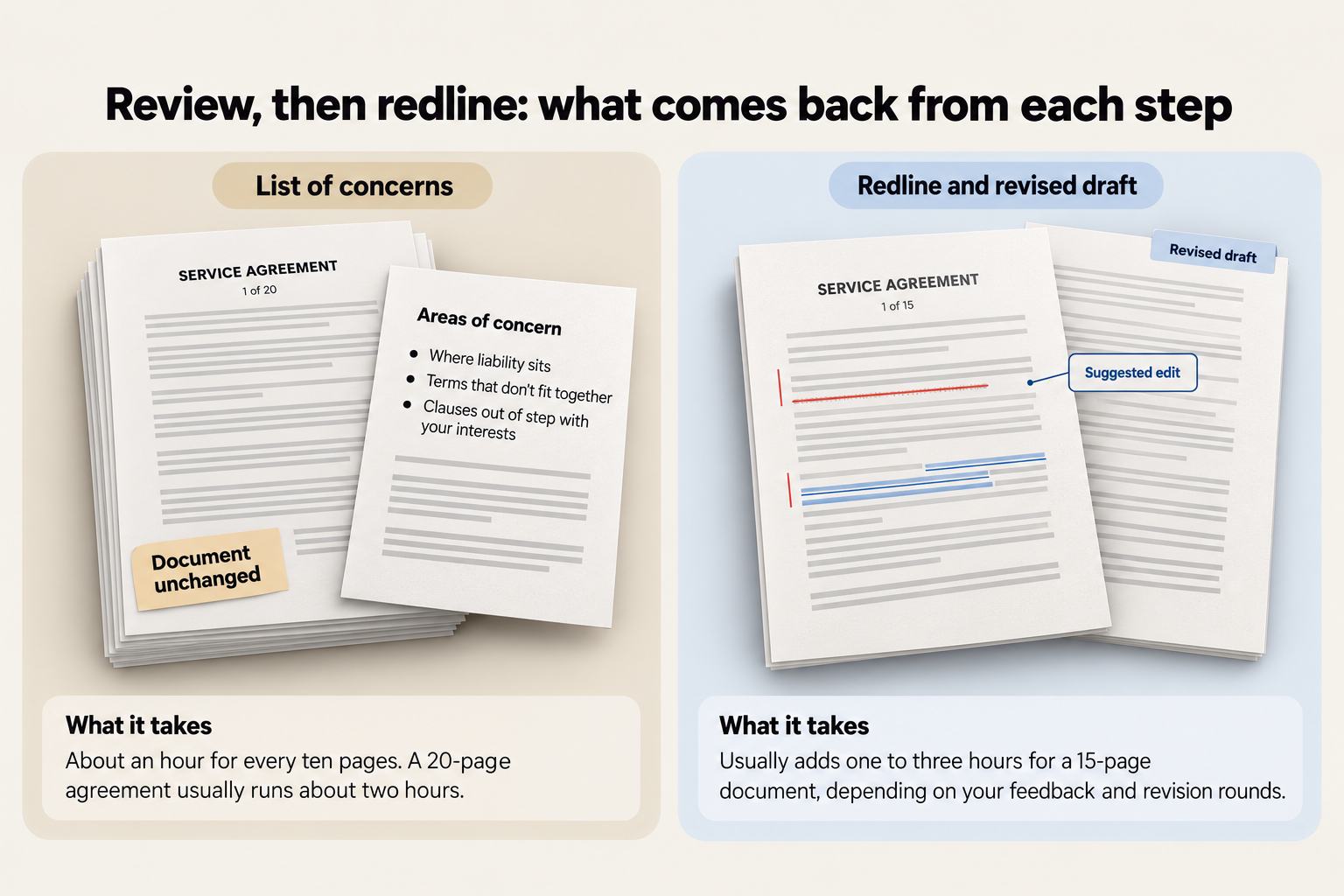
The list of concerns leaves your contract untouched. The redline is the contract itself, marked up with suggested edits.
This page walks through what each of those steps delivers and what pushes the hours up or down. It also covers how flat fees and hourly billing compare under New York and Florida rules, how to get one contract reviewed, and what a retainer agreement means.
The estimate above covers two different steps, and a lot of the field quotes them as one. Separated, you can decide how far you want to go before you spend the hours.
The first step is review: an attorney tests each line of the contract, checking how the terms fit together, where liability sits, and what looks out of step with your interests. What comes back is a bullet-point list of feedback and areas of concern, which some clients call an issues memo. The document itself is not changed.
If you want language ready to send back to the other side, the next step is a redline: a marked-up copy showing suggested edits line by line. A clean revised draft follows, incorporating whatever you accept.
| Deliverable | What you receive | When it fits | What it leaves to you |
|---|---|---|---|
| List of concerns | A bullet-point list of the contract’s issues and risk areas; the document itself is unchanged | You want to understand the risk before deciding how to respond | Deciding what to raise with the other side and whether to request a redline |
| Redline and revised draft | A marked-up copy showing suggested edits, plus a clean revised version incorporating what you accept | You want language ready to send back to the other side | Negotiating the specific changes and getting them accepted |
| Negotiation support | Direct back-and-forth with the other side on specific contested terms | A clause is contested and you want someone negotiating it for you | Final sign-off on the business terms |
| Follow-up call | A conversation walking through the list or the redline and answering your questions | You want to talk through what the markup means before you respond | Making the business decision on each point |
Which of these you need depends on what adds time to the document in the first place, and that comes down to the contract itself more than its label.
Some lawyers quote a contract review by the page, and others quote it by the hour, but the two usually land in the same place. Page count is the single biggest driver of how long a review takes. At our firm, the estimate above is exactly that: time estimated from how many pages you send over, not a separate per-page fee stacked on top.
Two things in particular push the hours beyond what the page count alone would suggest.
A commercial lease is often drafted to favor the landlord, and the same imbalance shows up in vendor or customer agreements written entirely by the other side. Working through that kind of contract takes longer than a mutual template, because every clause has to be checked against your interests rather than assumed fair.
Ultimately, total hours depend on how much information is contained on each page, and how complicated that information is, not simply on how many pages the document runs.
You also have some control over the hours, since a lot of what adds time is how the back-and-forth runs, not just the document itself. A few habits keep it efficient:
Review our full list of ways to get more out of your attorney’s time for the rest of these habits.
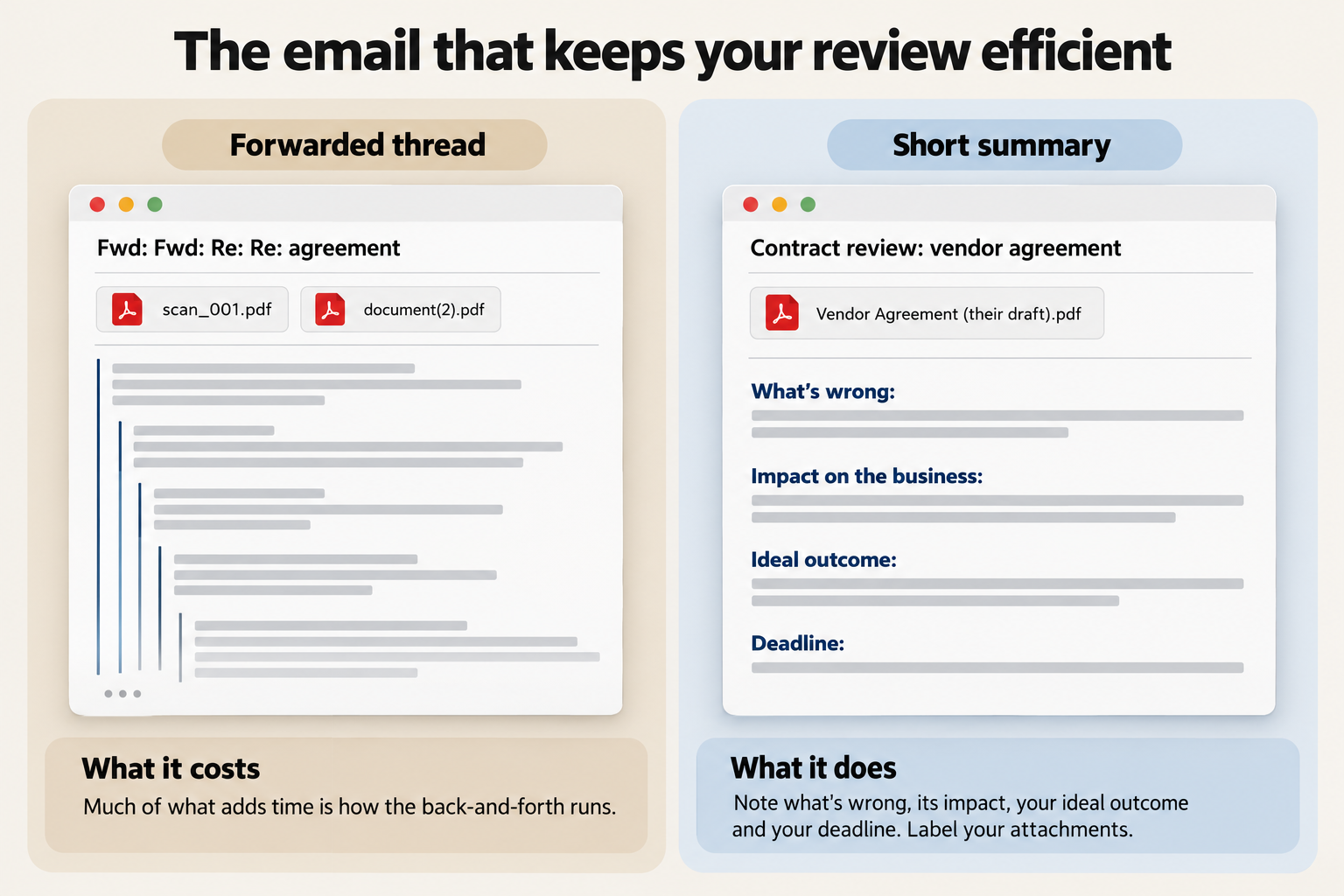
The short email gives your attorney what’s wrong, its impact, your ideal outcome and your deadline in four lines.
Once you know roughly how many hours your document will take, the next question is how you want to pay for them.
Two billing models cover almost every contract review: an hourly rate, or one fixed price for an agreed scope. Each one shifts the risk in a different direction.
An hourly rate works as follows:
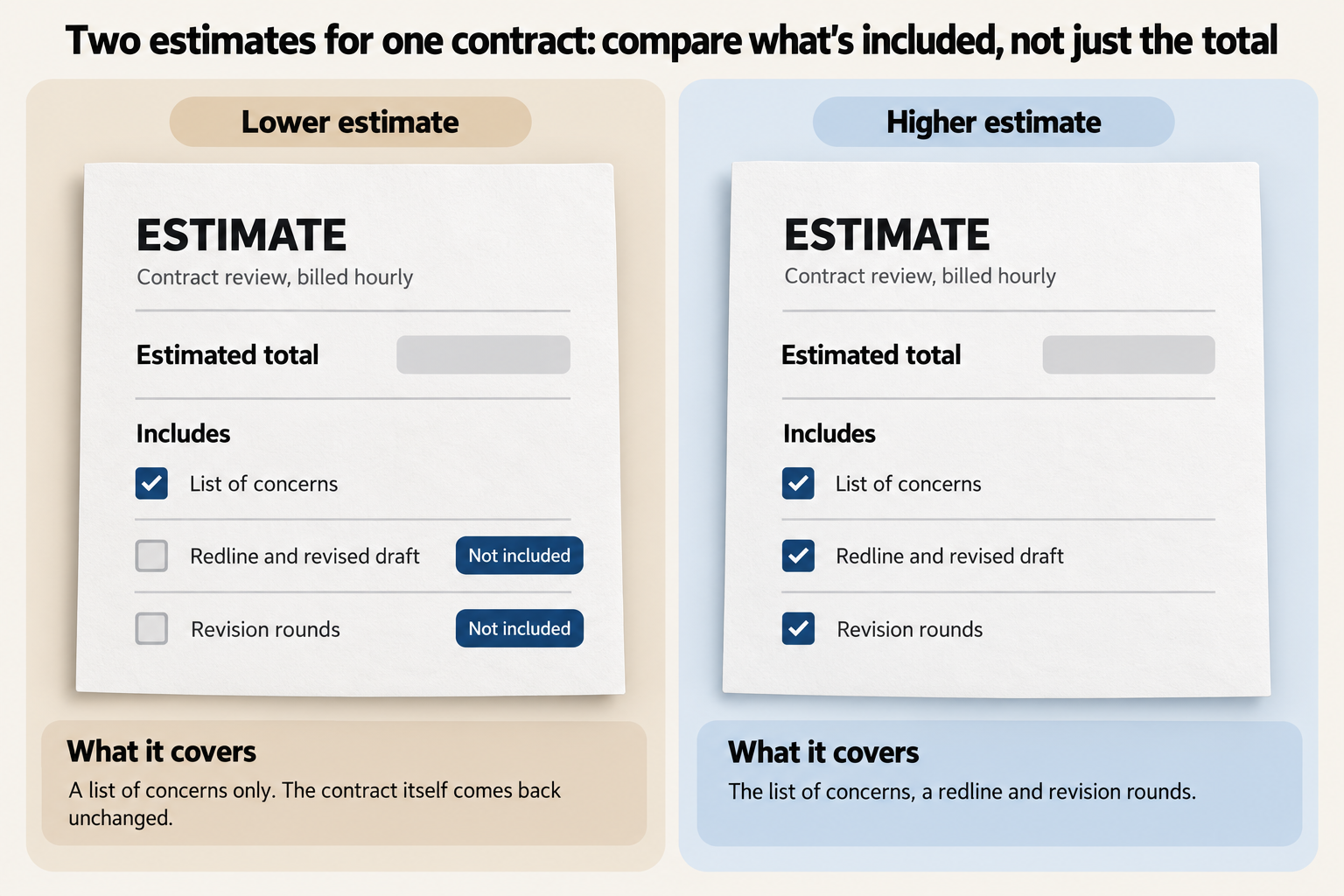
Ask for an estimate tied to the deliverable you want. The lower one here covers a list of concerns only.
A flat price works as follows:
In New York, you’re entitled to have your attorney explain, before or soon after work begins, how fees and expenses will be calculated and billed. You can also request a written itemized bill at reasonable intervals, under New York’s Statement of Client’s Rights.
In Florida, if any part of a flat fee is nonrefundable, that has to be confirmed in writing, setting out what the nonrefundable portion is for, under Florida Bar Rule 4-1.5(e).
We offer flat fees for legal entity formation and trademarks only. A contract review at our firm is billed by the hour, scaled to the page count, for the reasons above.
Billing by the hour does not mean billing without limit, and that is the next question worth settling before you start.
You can hire a business lawyer to review just one contract. Both states let an attorney take on a single, defined task instead of a full representation.
In New York, a lawyer may limit the representation to one task, such as reviewing a single contract, if the limitation is reasonable under the circumstances. You give informed consent by agreeing to the limit after your attorney tells you the material risks and the reasonable alternatives, under New York Rule of Professional Conduct 1.2(c).
In Florida, the same kind of limited engagement is allowed if it is reasonable given the circumstances, but your consent to the limit has to be in writing, under Florida Bar Rule 4-1.2(c).
At Lawyer For Business, we require all new clients to sign a retainer agreement with our firm before we do any legal work on their behalf. This allows us to put the scope and the fee in a written engagement letter, so we are both working from the same understanding of what is covered. You can also stop the engagement once that one contract is reviewed, since nothing obligates you to keep paying for ongoing work you did not ask for.
A few things are worth confirming in writing before the clock starts:
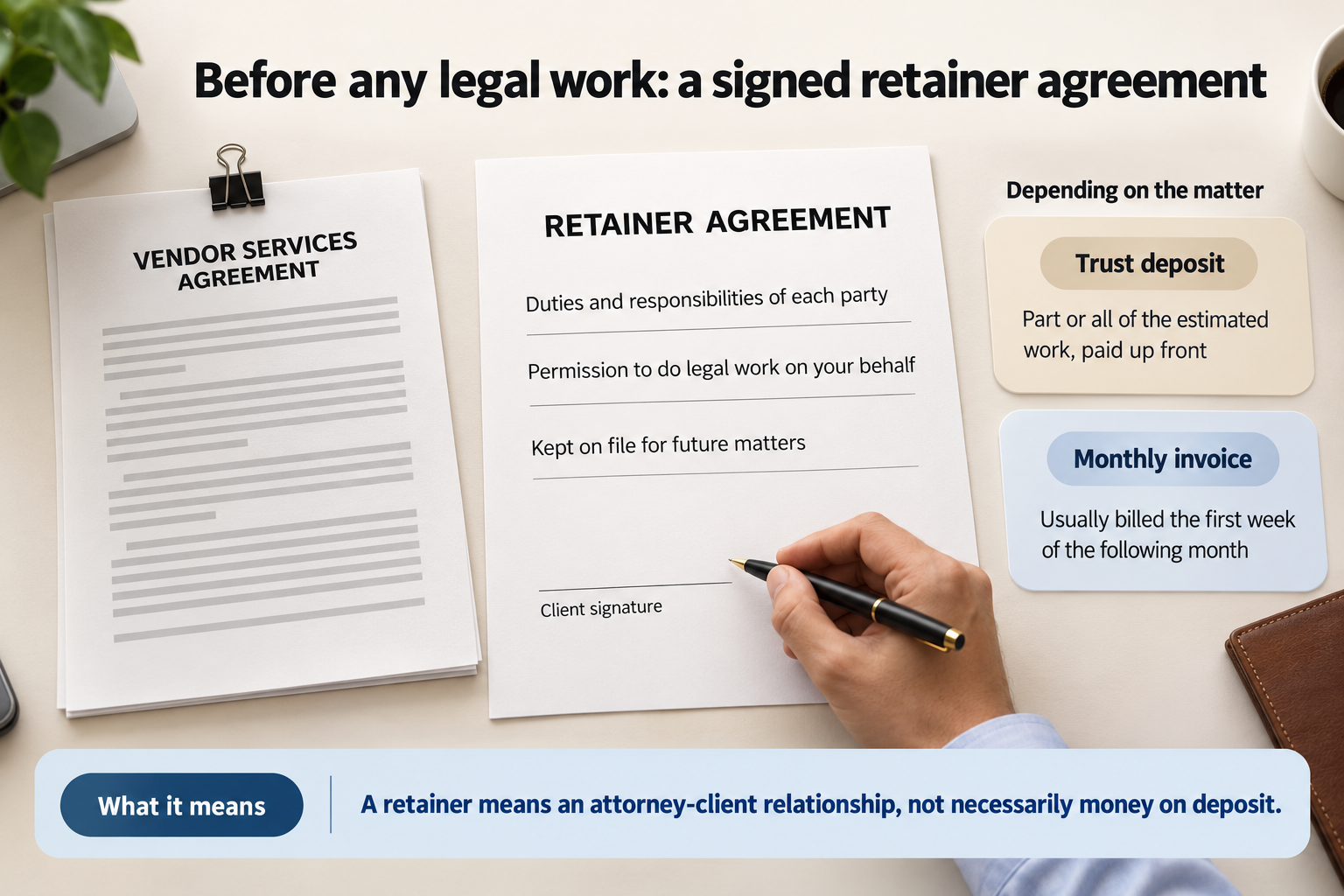
Every new client signs a retainer agreement before any legal work starts, and it stays on file for later matters.
Settling those four things tells you what the review will cost and when you will have it. What’s still worth asking is whether this particular contract is worth that cost at all.
Not every document needs an attorney’s time. The ones that do tend to share a few features.
A contract should always be reviewed by an experienced business attorney before you sign if it:
The cost of that kind of review is usually small compared to the cost of a dispute that was never prevented. Small businesses are often the most exposed to a poorly drafted agreement because no one caught it beforehand.
If your contract checks any of those boxes, the next question is simply who does the review and how to start.
Andrea A. Willis is a Florida Bar and New York bar member in good standing. She handles contract review for clients in both states. Our business contract lawyer practice serves clients across New York State and online, and drafts and negotiates contracts for them.
A Buffalo restaurant owner once asked us for a quick lease review before signing. The lease turned out to be heavily one-sided, with terms that could have threatened the business. Those terms were caught only because the client came to us before signing rather than after.
Consultations are fully virtual, by phone or video, so you can handle the entire matter online no matter where your business is located.
A new-client 45-minute consultation is $350, plus a nominal credit card processing fee, as of October 1, 2026.
If you have a contract you want reviewed, book a consultation and choose the calendar for your state.
Either way, the hours above are the real starting point. Once you know your page count and decide which deliverable you need, you can estimate the review before you ever pick up the phone.
Can ChatGPT review a contract?
AI tools like ChatGPT can be a useful starting point for reviewing a contract, but they should never finalize or approve a binding contract on their own.
A business lawyer should review the document before you sign, regardless of what drafted or marked it up first. We review and strengthen contracts drafted by AI tools before our clients sign them.
Is there a legal AI tool that can review contracts?
AI tools exist that can scan a contract for common issues, but none of them is a substitute for a licensed attorney looking at your specific document.
AI predicts likely text patterns rather than understanding your business, and it is not licensed and owes you no fiduciary duty the way a lawyer does. It is also worth being careful about what you put into a public AI tool, since a lawyer owes you confidentiality and privilege and most AI platforms do not.
What are the key differences between a flat fee and an hourly rate?
A flat fee is one fixed price for an agreed scope of work, while an hourly rate bills for the actual time spent, however long that takes.
Business lawyers use hourly billing, flat fees or a retainer depending on the matter, covering work that ranges from document review and negotiation to legal guidance and closing work.
The information you obtain at this site is not, nor is it intended to be, legal advice. Contacting us does not create an attorney-client relationship. Please do not send any confidential information to us until such time as an attorney-client relationship has been established.