Agreeing on a price with a buyer feels like the hard part of selling a small business in New York. Legally, it’s step three of five, and the two steps most sellers skip past are the ones that decide who owns the risk after closing.
The sequence runs in five steps: get the company’s records and protections in order, then decide whether you’re selling the assets or the ownership interests and secure any required approval. Next, sign a letter of intent before you pay for a purchase agreement, work through New York’s Tax Department steps for a sale of business assets, and close. Each step has its own paperwork, and some of it runs on a clock neither side controls.
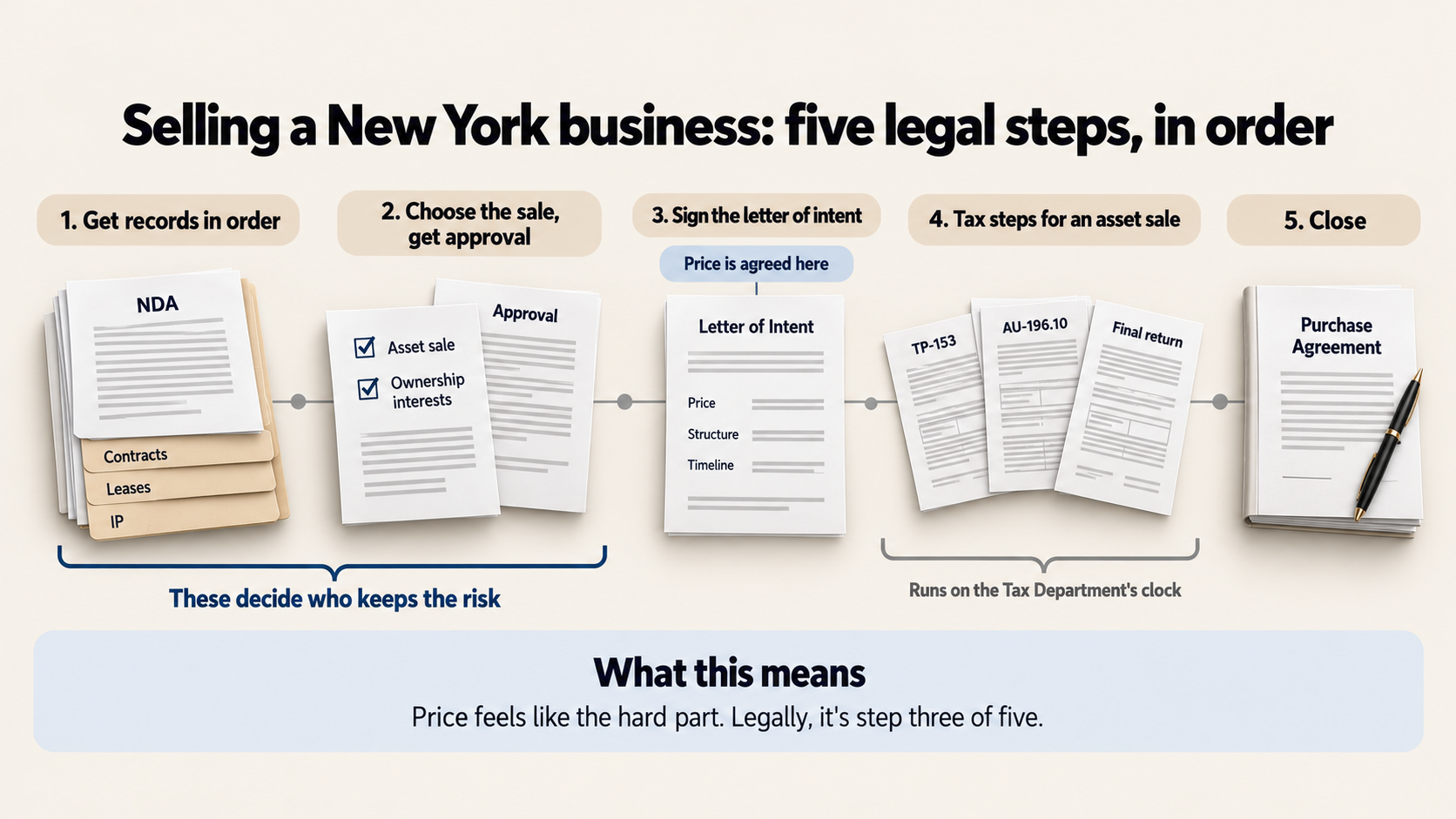 Price is agreed at step three. The two steps before it decide who keeps the risk.
A lawyer should review the deal before the letter of intent is signed, and at the latest before the purchase agreement.
This guide walks through each step in order, with the New York statute or Tax Department rule behind it, then the legal issues that commonly hold up a closing before price ever does.
For sellers, the preparation starts months before an offer arrives. Know what you’re selling, because outdated contracts, unclear intellectual property ownership, or missing records hand a buyer leverage before negotiations even open.
Before you share anything with a prospective buyer:
Getting the records straight tells you what you have. It doesn’t yet tell you who inside the company gets to say yes to selling it.
A sale of a small business in New York is one of two different transactions. An asset sale is the buyer purchasing the business’s assets, equipment, inventory, contracts, goodwill, sometimes the name, while your entity keeps its own history and, unless the deal says otherwise, its past liabilities. A sale of the ownership interests is the buyer purchasing your membership interests or shares directly, so the entity changes hands as a whole, liabilities included.
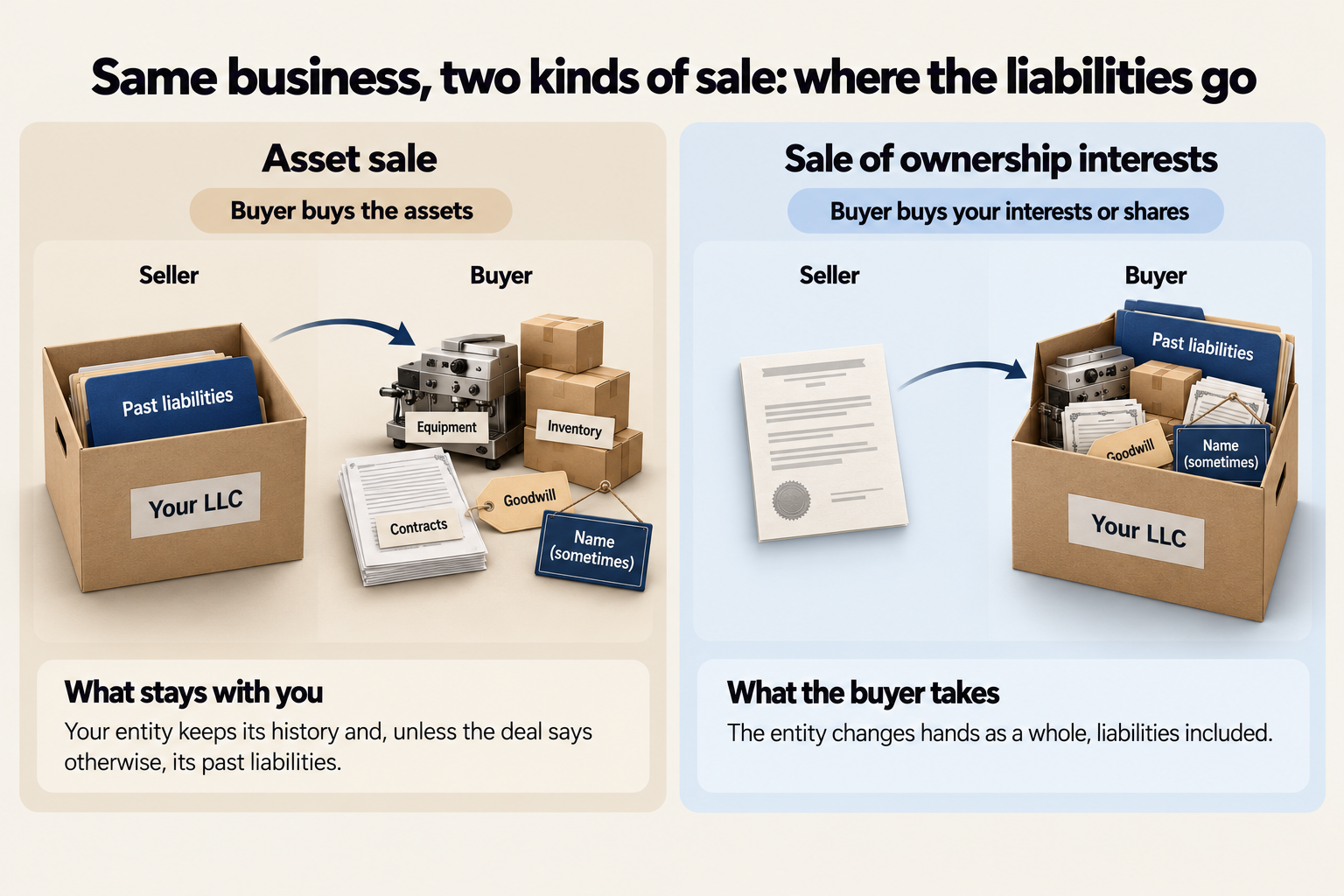 In an asset sale your entity keeps its past liabilities unless the deal says otherwise. In a sale of the ownership interests, they go with the entity.
The choice between the two changes who keeps which risk, and it’s worth understanding before you negotiate either document. Discuss it with both your attorney and your tax advisor before you sign anything. One is managing the legal risk, the other the tax bill.
For an LLC selling substantially all of its assets, New York law sets a default rule: except as the operating agreement provides, the sale takes the vote of at least a majority in interest of the members entitled to vote (NY LLC Law § 402). If your company is a corporation rather than an LLC, the approval that applies comes from your bylaws and any shareholder agreement, and that’s worth having your attorney check before you commit to anything.
Once you know who has to say yes, you need something for them to say yes to.
One common mistake sellers make is paying a lawyer to draft a purchase agreement before buyer and seller agree on the basic terms. A signed letter of intent first can save sellers thousands of dollars in legal fees, because it fixes the price, structure and timeline before either side pays for the document that makes the deal binding.
Before you sign the LOI, check:
LOIs themselves can be binding or non-binding, and any deposit can be negotiated as refundable or non-refundable. Have your attorney review the LOI with you before you sign it, not after.
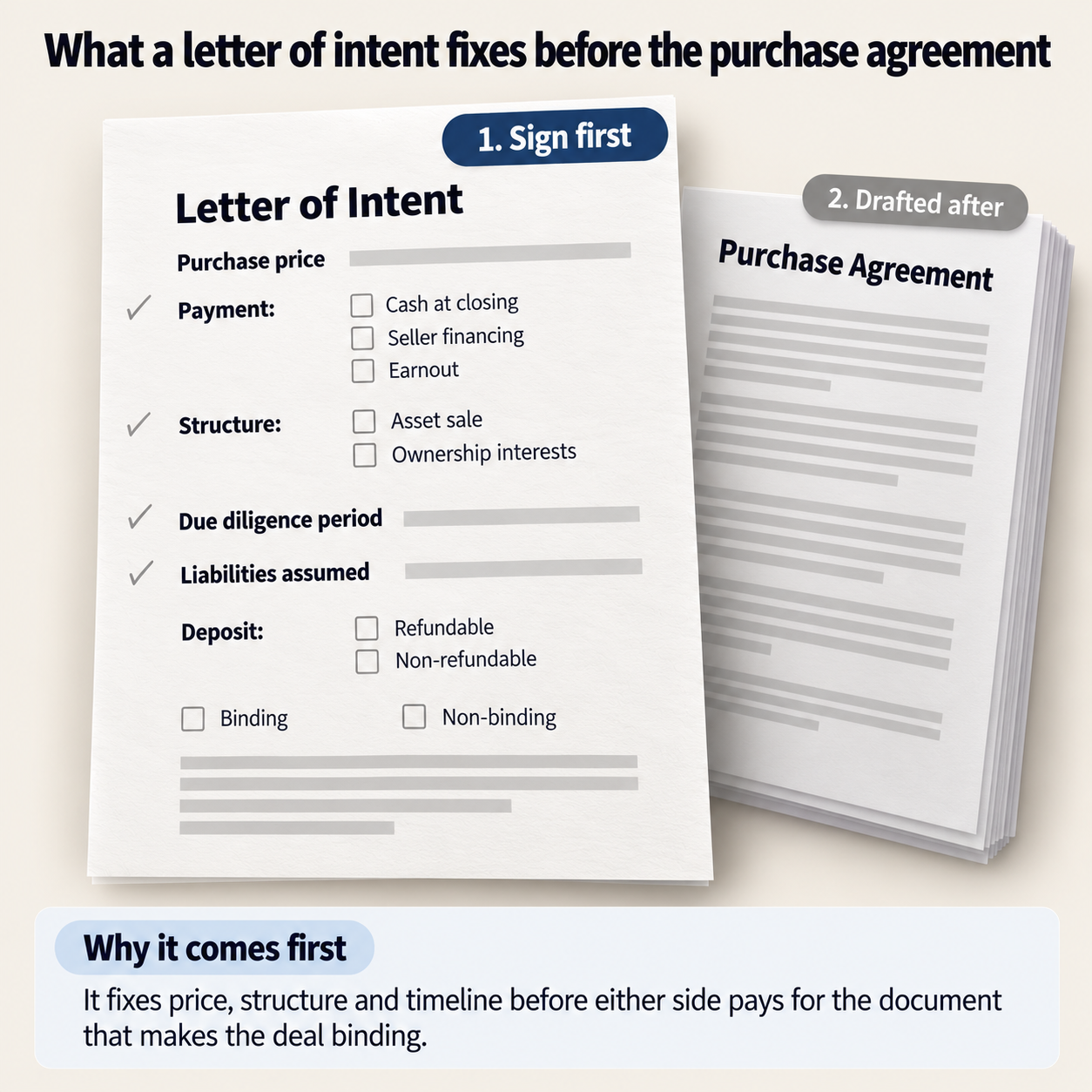 The letter of intent settles price, structure and timeline before anyone pays for the purchase agreement.
Once the LOI is signed and due diligence gets underway, a separate clock starts running if you’re selling business assets. That clock belongs to New York’s Tax Department.
These steps apply if you collect New York sales tax and sell business assets outside the ordinary course, called a bulk sale. What buyers sometimes call a “tax clearance” is not a separate certificate. The term refers to this sequence of notice and response.
| Step | Who does it | When | Form | Where it’s written |
|---|---|---|---|---|
| Notify the buyer of the bulk sale | Seller | Before the sale is completed | TP-153, Notice to Prospective Purchasers | TP-153 instructions |
| Notify the Tax Department | Buyer | At least 10 days before taking possession of or paying for the assets, whichever is earlier | AU-196.10 | TP-153 instructions |
| Exposure if notice is late or missing | Buyer, personally, for the seller’s unpaid sales tax | If AU-196.10 isn’t filed on time | No form; this is a liability, not a filing | Tax Law § 1141(c) |
| File the final sales tax return | Seller | Within 20 days after the sale | Final sales tax return; surrender or destroy the Certificate of Authority | Tax Bulletin ST-265 |
These steps are silent on a sale of membership interests or shares. TP-153 and the bulk-sale rules speak to a sale of business assets, not to an equity sale.
A buyer who doesn’t notify the Tax Department on time is personally liable for the seller’s unpaid sales tax, up to the purchase price or the fair market value of the assets, whichever is higher (Tax Law § 1141(c)). That’s the buyer’s exposure, not the seller’s, and it’s exactly why a buyer’s counsel will usually insist on holding back part of the purchase price until the notice period has run.
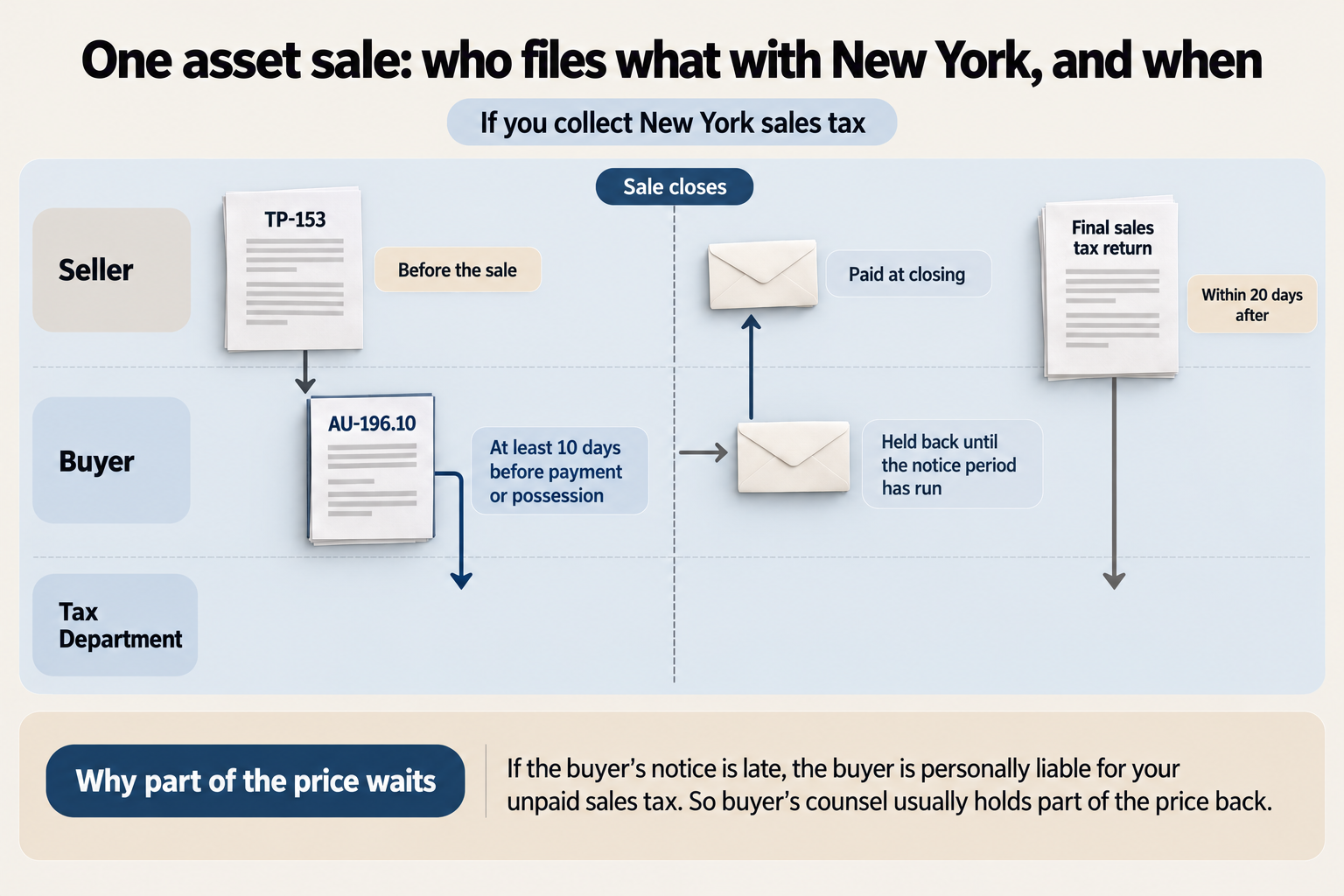 Part of the price waits because a buyer whose notice is late is personally liable for the seller’s unpaid sales tax.
None of this depends on whether a price has been agreed. It depends on whether you collect sales tax and whether the assets changing hands are substantial, and price is often a smaller obstacle than sellers expect it to be.
Agreeing on a price is not the same thing as agreeing on the deal. The purchase price is usually the figure buyers and sellers settle first, long before the sale is ready to close.
What holds things up instead is usually one of four issues:
Lease issues in particular are one of the most common reasons buyers renegotiate a deal after the price is already set.
Our firm has seen this directly. In one transaction, the parties were initially focused primarily on the purchase price. As the transaction progressed, however, the more significant negotiations involved the seller’s post-closing exposure.
Negotiating consents, indemnities and lease assignments is where legal work earns its cost. Whether you handle that yourself or involve an attorney is the next question.
A lawyer is the one who turns an agreed price into an agreed deal. The roles are different, not interchangeable: a broker finds and negotiates with buyers, while a lawyer handles the legal consequences, the protections, the agreements and the risk allocation a price tag never covers.
That’s why our firm recommends getting a lawyer’s eyes on the deal before the letter of intent is signed, and at the latest before the purchase agreement. For more on what a broker’s role does and doesn’t cover, see our broker versus lawyer guide.
Legal fees for a sale or purchase depend on the transaction’s complexity, not the purchase price alone. At Lawyer For Business, our fees for a business purchase or sale depend on the matter and are discussed at your consultation. For what typically drives that figure in New York, see our New York sale cost guide.
On the New York side, we draft and respond to letters of intent. We also prepare purchase agreements with seller-protective terms, structure indemnities, representations and warranties, and coordinate with the buyer’s counsel through closing. Our New York business purchase and sale practice handles this work end to end, for both buyers and sellers.
A New York sale with our firm involves four steps:
Andrea A. Willis is a Florida Bar and New York bar member in good standing. We represent buyers and sellers across New York, including Buffalo, Albany, Rochester and New York City. Consultations are fully virtual, conducted by either phone call or video call, and you can handle the entire matter online without setting foot in an office.
Here is how Andrea describes the value of representing both sides of a deal:
You want a business lawyer who understands how both buyers and sellers approach a transaction. Because we represent both sides in business acquisitions, we understand what each party is looking for, where negotiations typically get difficult, and where important protections can be overlooked.
My job is not simply to get you to closing. Getting legal advice early can save you significant time, legal fees, and costly surprises after closing.
At Lawyer For Business, a new-client 45-minute consultation is \$350, plus a nominal credit card charge, as of October 2026. Book a New York business consultation to start.
Selling the business and closing the entity are two different steps. You shouldn’t prepare or file the entity’s dissolution paperwork yourself, since mistakes there can be costly.
See our guide to dissolving a New York LLC for the full process once the sale is done.
A New York LLC files Articles of Dissolution with the Department of State within 90 days after dissolution and the start of winding up.
The filing is made with the New York Department of State, separately from anything required by the sale itself.
The Department of State’s filing fee for Articles of Dissolution is $60, as of October 2026.
That’s the state’s fee only. The firm’s own fee for handling a dissolution isn’t published and is discussed at your consultation.
The information you obtain at this site is not, nor is it intended to be, legal advice. Contacting us does not create an attorney-client relationship. Please do not send any confidential information to us until such time as an attorney-client relationship has been established.