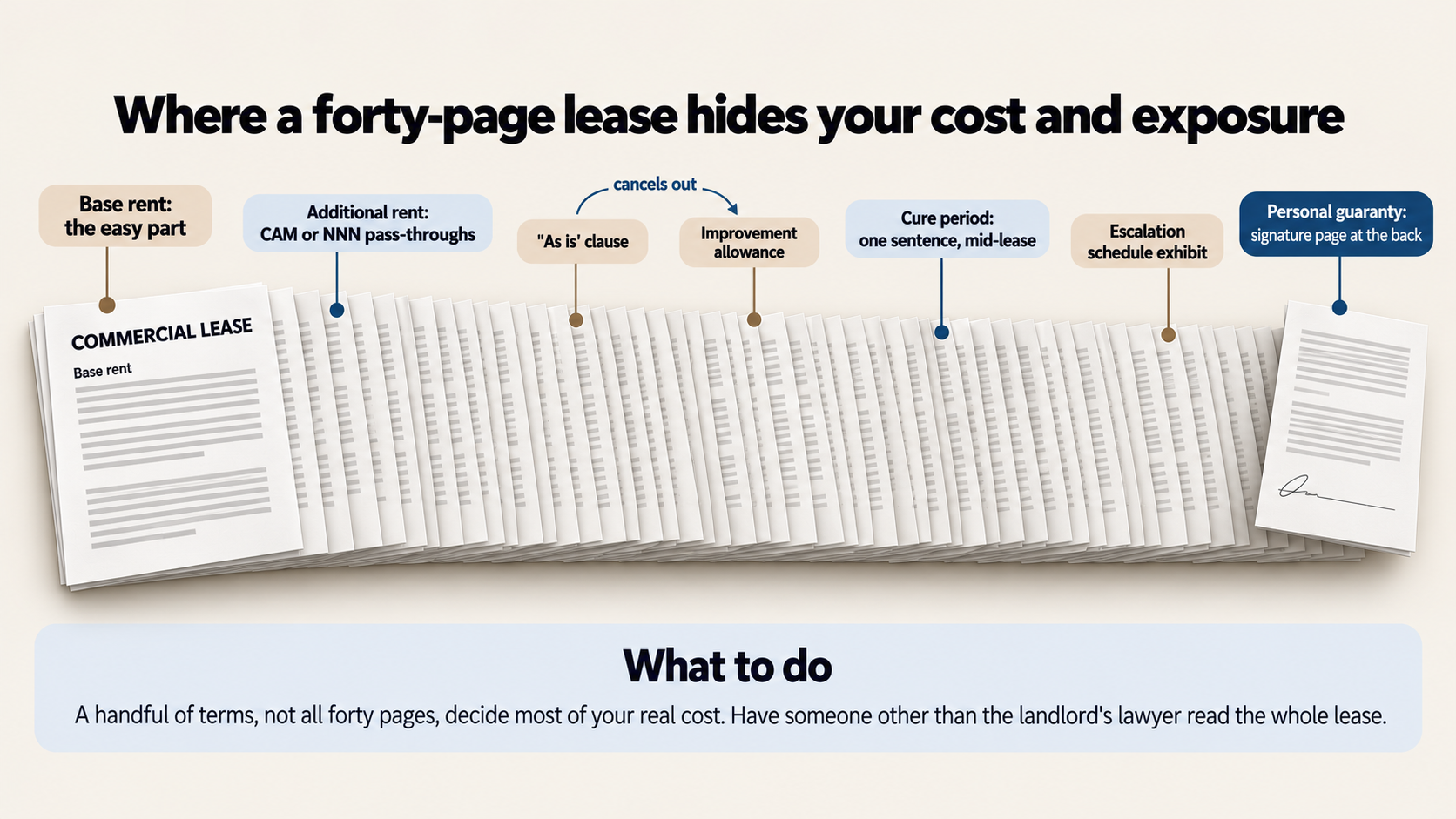
Your landlord just handed you a forty-page commercial lease and asked for a signature by Friday. The rent on page one is the easy part to understand. What that rent actually costs you over ten years, and whether you’re personally on the hook for it, is buried somewhere in the other thirty-nine pages.
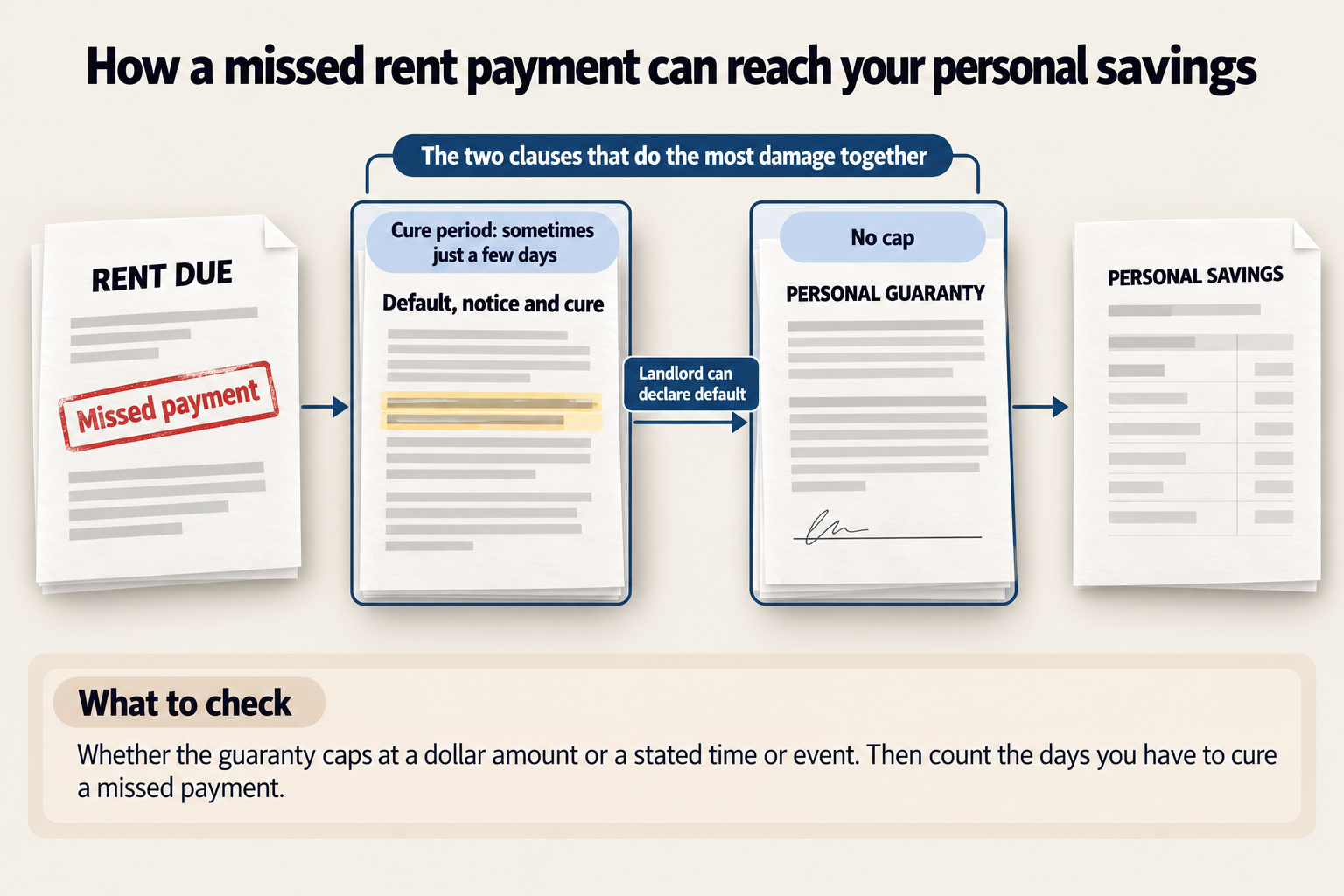
A lease with the wrong default clause can reach your personal savings. A lease with the wrong assignment clause can trap you in the space long after you’ve decided to leave.
These leases are usually drafted to favor the landlord. Most of them are negotiable, and the one move you can’t undo is signing before someone has read the whole thing.
Before you sign, check eight things first. Review total occupancy cost beyond base rent, any personal guaranty, and when rent starts compared with delivery of the space and your build-out schedule. Also check who pays for major repairs, what the permitted use clause lets you do, and whether you can assign the lease if you sell the business. Finally, check your renewal terms and how default and cure work. Then have someone other than the landlord’s lawyer review the lease before your deadline passes.
What follows is a term-by-term lookup for New York leases and what owners typically miss around the lease itself.
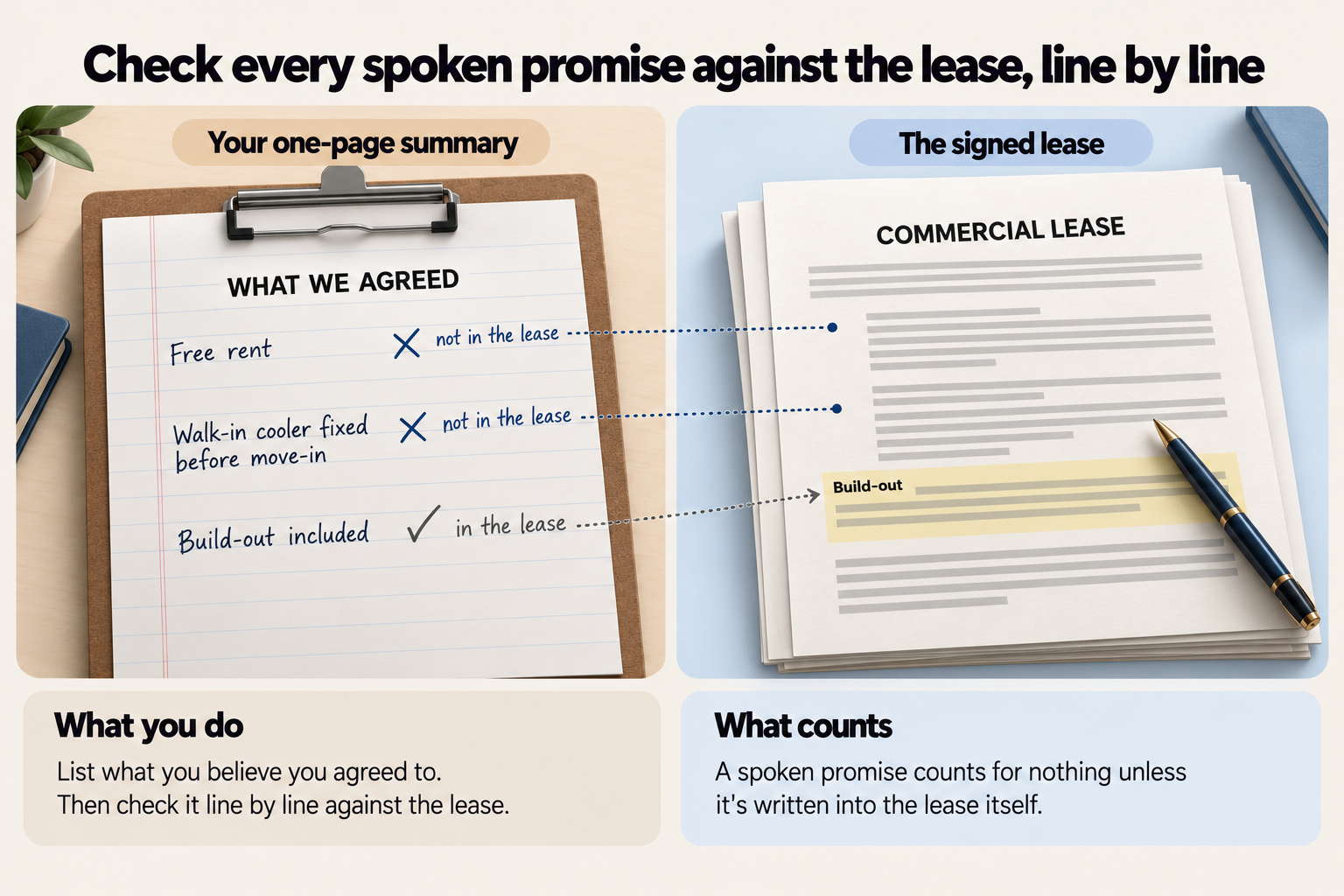
A short deadline is a negotiating position, not a legal one. What the landlord needs by Friday has no bearing on what the signed document says. Nothing said in conversation protects you once a dispute comes up later.
New York law backs this up for anything beyond a year. Under New York General Obligations Law § 5-703, a lease of real property for longer than one year is void unless it is in writing. The writing has to be signed by whoever you’re trying to hold to its terms, or by their agent.
That means a landlord’s spoken promise, about free rent or about fixing the walk-in cooler before you move in, counts for nothing unless it’s written into the lease itself.
Put every promise that matters into the signed document, not into an email thread or a phone call. If it isn’t written down, it isn’t part of the deal.
A lease is exactly the kind of long-term, high-dollar obligation that should go to a business attorney before you sign, not after. The deadline is a reason to move quickly toward that review, not a reason to skip it.
Three things get you ready to act on the deadline instead of being run by it:
Once you know the signed document is the whole deal, the next question is which parts of it carry the real cost and exposure.
The clause doing the most work in your total cost is rarely the base rent number on page one. It’s whatever sits behind “additional rent,” starting with pass-throughs for common area maintenance, known as CAM. If this is a triple net lease, also written NNN, add your share of property taxes and insurance on top of rent.
The table below covers the ten terms that most often decide total cost and personal exposure over the lease term. For each, it gives the question to ask the landlord and, where one exists, the New York rule.
| Term | What it decides | Where it usually hides | Question to ask the landlord | New York rule |
|---|---|---|---|---|
| Total occupancy cost | Your real monthly cost across the term, not the headline rent | The “additional rent” clause and the escalation schedule | What is my total occupancy cost in year one and year five, after escalations and pass-throughs? | |
| Personal guaranty | Whether your personal assets are on the line if the business can’t pay | A separate signature page or an exhibit at the back of the lease | Does the guaranty cap at a dollar amount or a time period, and does it end if I sell the business? | |
| Rent commencement and delivery of possession | When you start paying rent versus when you can actually open | A rent commencement date decoupled from the delivery date in a work letter or exhibit | What happens to my rent if the space isn’t delivered on the promised date? | Unless the lease says otherwise, New York law assumes the landlord will deliver the space at the start of the term. If that’s breached, the tenant can cancel the lease and recover what they paid, under New York Real Property Law § 223-a. |
| Build-out, tenant improvement allowance and “as is” condition | Who pays to make the space usable, including systems like a hood, grease trap or walk-in cooler | An “as is” clause earlier in the lease that cancels out an allowance promised later | Is the improvement allowance paid up front or reimbursed after inspection, and what happens to any unused balance? | |
| Repairs and major systems | Who pays when the HVAC, roof or plumbing fails mid-lease | A narrow definition of “structural repairs” that excludes the system that actually breaks | Who pays to repair or replace the HVAC system, and is my share capped? | |
| Permitted use and exclusivity | What you’re allowed to do in the space now, and whether you can change concept later | A use clause written narrowly around your original pitch to the landlord | Can I add delivery, catering or alcohol service later without the landlord’s separate approval? | |
| Assignment and subletting | Whether you can sell the business or sublet the space, and on what terms | A consent requirement that looks routine until you read what triggers it | Can I assign the lease to a buyer of my business without the landlord’s separate approval? | |
| Renewal options and renewal rent | Whether you can stay past the initial term, and at what rent | A renewal clause that resets rent to “fair market value” with no formula attached | How is renewal rent calculated, and who decides if we disagree on “fair market”? | |
| Default, notice and cure | How much time you get to fix a missed payment or violation before the landlord can act | A cure period stated in a single sentence mid-lease, sometimes just a few days | How many days do I have to cure a missed rent payment before the landlord can declare default? | |
| Security deposit | How much cash is tied up for the length of the lease, and what you get back | A deposit clause pages away from the rent clause, with its own return conditions | Where is my deposit held, and what conditions let the landlord keep part of it? | A security deposit remains the tenant’s money. It must be held in trust, kept separate from the landlord’s own funds, and any lease language waiving this protection is void, under New York General Obligations Law § 7-103. |
Escalations are usually written one of three ways: a fixed percentage each year, an increase tied to the Consumer Price Index, or a stepped schedule that sets the rent for each year in advance. Look for them inside the “additional rent” clause and any escalation schedule attached as an exhibit, not in the base rent paragraph itself. Add any CAM or NNN pass-throughs on top before you compare your actual year one and year five cost.
Two of these rows do the most damage together: a personal guaranty with no cap, paired with a short cure period on default. Check whether the guaranty caps at a dollar amount or a stated time or event. Then count the days the default clause gives you to cure a missed payment before the landlord can act.
The clauses above are what’s written down. Some of the costliest mistakes happen around the lease, in what nobody checked before signing or asked for during negotiation.
Before you sign, check:
That assignment clause carries more weight than it appears to. In our experience, lease issues are one of the most common reasons buyers renegotiate a business purchase. A restrictive assignment clause can turn the lease itself into the obstacle to closing.
None of this gets fixed by reading faster. It gets fixed by having someone else read it with you before you sign.
A real lease review usually involves four things:
Andrea A. Willis is a Florida Bar and New York bar member in good standing, and our firm represents clients across New York State, including Buffalo, Albany, Rochester and New York City.
We negotiate New York commercial leases directly with landlords, on rent, duration, renewal and permitted use, and we review leases before clients sign them.
We’ve seen what a late review costs. A restaurant owner in Buffalo came to us for a quick lease review before signing, and reached out before executing it. The lease was heavily one-sided against them, with terms that could have put the business at serious risk if signed as written.
Our New York Business Consultation can help answer your initial questions about your lease and goals. After the consultation, we will outline what a fuller full lease review, redline, and negotiation would involve, along with expected cost and turnaround time. The consultation session can also cover your questions about other matters, such as a contract or a business purchase, depending on what you bring to it.
Consultations are fully virtual, by phone or video, and the entire matter can be handled online without setting foot in an office.
If your signing deadline is this week, book a New York Business Consultation and bring the lease with you.
How much are legal fees for a commercial lease?
Fees for a lease review vary by the lawyer and the scope of work, so there’s no single market rate. Our own New York Business Consultation is 45 minutes for $350, as of October 1, 2026, and its scope includes discussing your commercial lease. Full lease review, redlines, negotiations, and feedback are discussed during the consultation and billed at our hourly rate.
We offer flat fees for legal entity formation and trademarks only, so a lease review itself is not quoted as a flat fee.
How long does it take to review a commercial lease?
It depends on the lease’s length, how many riders and exhibits it has, and how many rounds of comments go back and forth with the landlord. We try to give an estimated turnaround for a lease review, so you can plan ahead.
Can AI review a lease agreement?
AI can be a useful starting point for understanding a lease, but it isn’t a substitute for a lawyer’s review before you sign.
AI tools predict patterns in text. They don’t apply legal judgment to your specific lease, hold a license, or owe you any duty to get it right. That’s why we see them as useful for getting oriented before a lawyer looks at the actual document, not as the final check.
How do you negotiate a commercial lease agreement?
Start by knowing your ideal outcome and the minimum you’ll accept, and have a fallback plan before you make your first counter.
Don’t negotiate against yourself by conceding before the other side responds, and don’t give up a point without asking for something back. We cover the full set of negotiation tactics, including how to use silence and when to involve a lawyer, in our guide to negotiating a commercial lease.
The information on this page is not, and is not intended to be, legal advice. Contacting our firm does not create an attorney-client relationship, and you should not send confidential information until that relationship has been established.