No. A business broker’s standard contract protects one thing well: the broker’s commission. It says almost nothing about who absorbs the risk if the landlord won’t assign the lease, or what happens when a customer contract turns out to need a consent nobody budgeted time for.
The roles are different, not interchangeable. A broker finds and negotiates with buyers. A lawyer handles the legal consequences, the protections, the agreements, and the risk allocation a price tag never covers, and turns an agreed price into an agreed deal.
We tell Florida sellers plainly that a broker isn’t required to sell, though a broker can widen your pool of buyers. Either way, the legal consequences of the deal still need a lawyer’s reading, broker or no broker.
This guide sorts out which paper does which job: the listing agreement that runs between you and the broker, the letter of intent that often sets terms before your own counsel reads them, and the purchase agreement that actually carries the risk, for sellers and buyers in New York and in Florida.
Three advisers can touch a sale, and each one is reading the deal for something different. Here’s where each one’s job starts and stops.
| Task | Business broker | Business lawyer | CPA or tax advisor |
|---|---|---|---|
| Find and screen buyers | Markets the business and screens buyer interest | Not typically involved at this stage | Not typically involved at this stage |
| Negotiate the price | Often leads early conversations | Reviews and negotiates terms once an offer is on paper | Not typically involved |
| Due diligence | Not typically involved | Coordinates the legal review: lease, contracts, liabilities, IP | Reviews the financial records |
| Structure the sale for tax purposes | Not typically involved | Works with your tax advisor on the structure | Advises on the tax treatment |
The U.S. Small Business Administration says selling a business takes a sales agreement covering the purchase of assets or stock, reviewed by an attorney for accuracy and completeness. It should list the inventory, the parties, any price adjustments, and the broker’s fee, and leave out no assets or liabilities. That holds whether the business sits in New York or in Florida.
Discuss the structure, an asset sale or a stock sale, with both your attorney and your tax advisor before you sign anything. The two advisers are answering different questions, one managing the legal risk, the other the tax bill. Before either of them can do that work, though, you need to know which of the broker’s own documents actually binds you, and which one is just the start of the deal.
A broker hands you two different kinds of paper over the course of a sale, and only one of them is actually yours.
The listing agreement is a contract between you and the broker. It sets the broker’s commission and the length of the engagement.
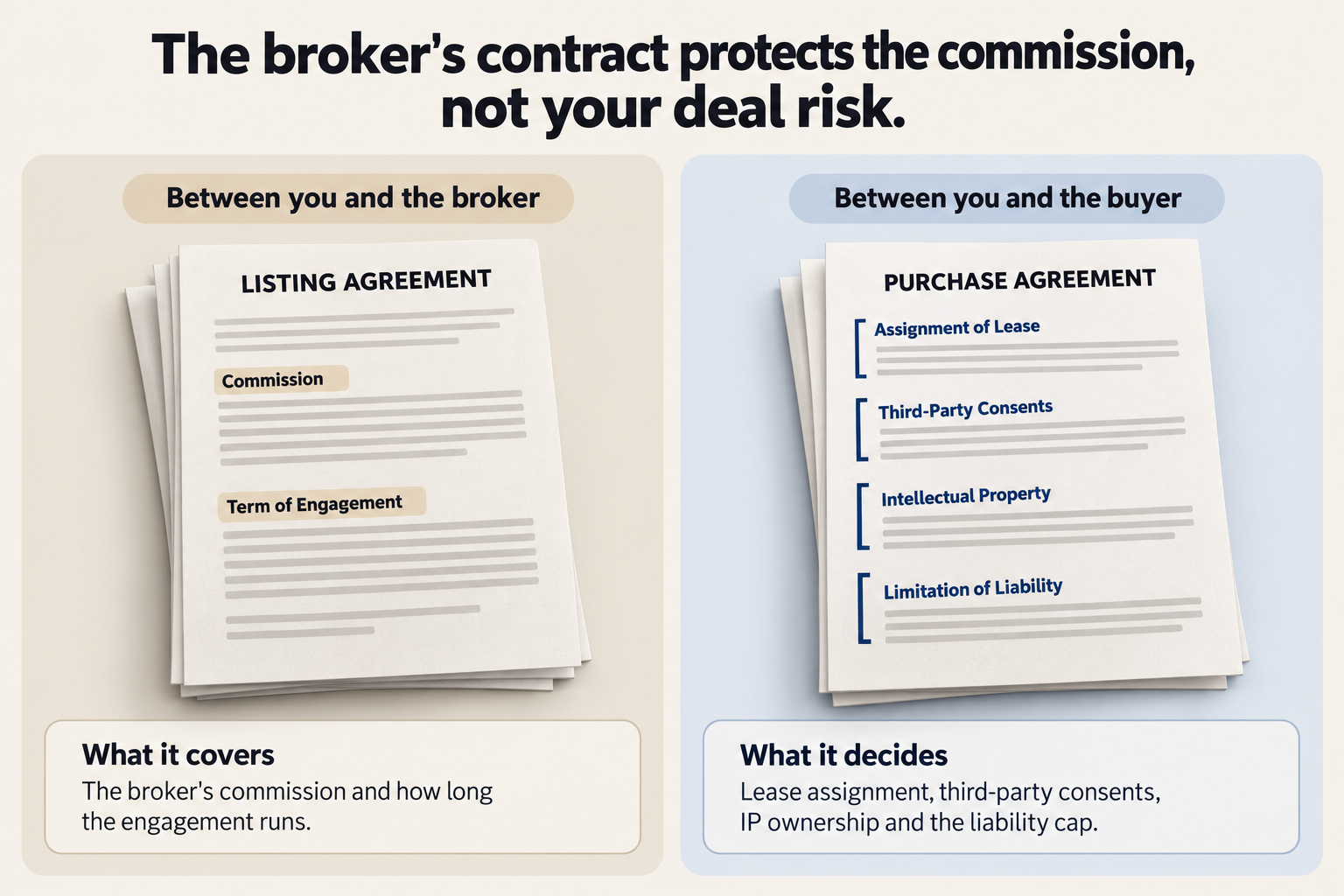 The broker’s contract protects the commission and sets how long the engagement runs. The purchase agreement decides the lease, consents, IP ownership and the liability cap.
In New York, a contract to pay someone for negotiating the purchase or sale of a business must be in writing and signed to be enforceable, under General Obligations Law section 5-701(a)(10). The statute’s definition of “negotiating” reaches further than drafting the deal. It covers procuring an introduction to a buyer, or otherwise assisting in the negotiation, which means a broker’s commission promise that was never put on paper can be unenforceable in a New York court.
The offer or LOI form the broker hands you often doubles as the starting point for the actual deal terms. It usually doesn’t come from your lawyer, and it can set a price, a structure, and a timeline before anyone who represents only you has read it.
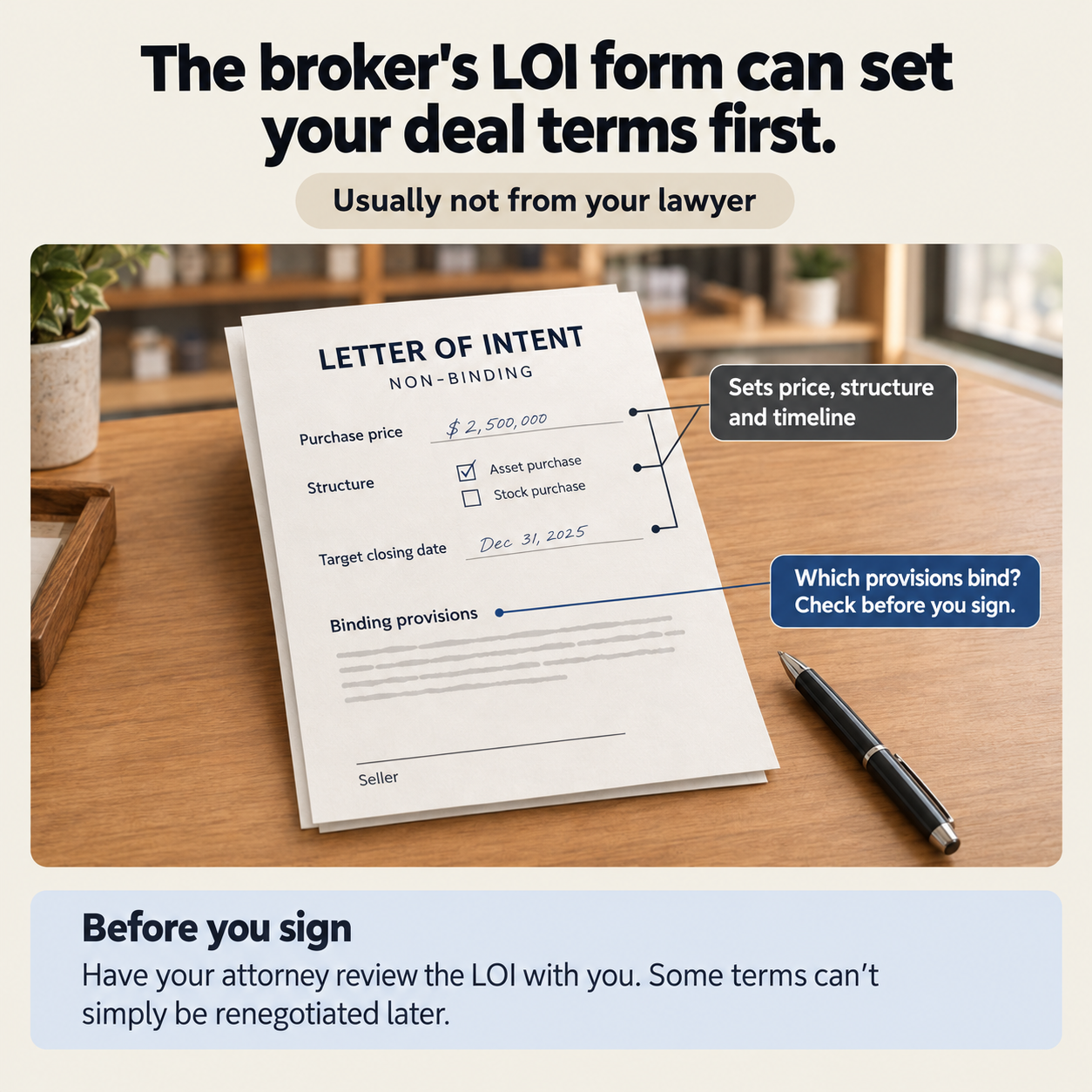 The broker’s LOI form can set your price, structure and timeline first. Have your attorney review it with you, and check which provisions bind, before you sign.
You should never sign a contract you do not fully understand. Any contract touching money, liability, ownership, employees, intellectual property, or a long-term obligation should be reviewed by a business attorney before you sign it, not after.
The broker’s paperwork gets the deal started. The purchase agreement is where the questions that matter get negotiated.
A price is the number everyone agrees on first. We’ve found it’s rarely what delays or derails a closing. More often it comes down to whether the commercial lease can be assigned, whether customer contracts need a third party’s consent, whether the seller actually owns the intellectual property, or whether the equipment on the floor was ever properly identified in the agreement.
Due diligence and the purchase agreement are where these questions get answered:
Due diligence exists to show you exactly what you’re buying before money changes hands, not to kill the deal. Some of the biggest issues never show up on a balance sheet. Finding a problem before closing gives you options, and finding it after closing usually gives you a bill.
For sellers, the preparation starts months before an offer arrives. Know what you’re selling, since outdated contracts, unclear IP, or missing records hand the buyer leverage. Require an attorney-drafted NDA before you share anything, and watch for broad, uncapped indemnification language in what you sign.
A New York buyer has one more step before closing: the bulk-sale notice. Under the Department of Taxation and Finance’s rules on bulk sales, a buyer purchasing business assets outside the seller’s ordinary course of business must file Form AU-196.10 at least 10 days before paying for the assets or taking possession, whichever happens first, by registered or certified mail or hand delivery. Within 5 business days, the Department responds with either a Purchaser’s Release (Form AU-197.1) or a Notice of Claim to Purchaser (Form AU-196.2) if the seller owes tax.
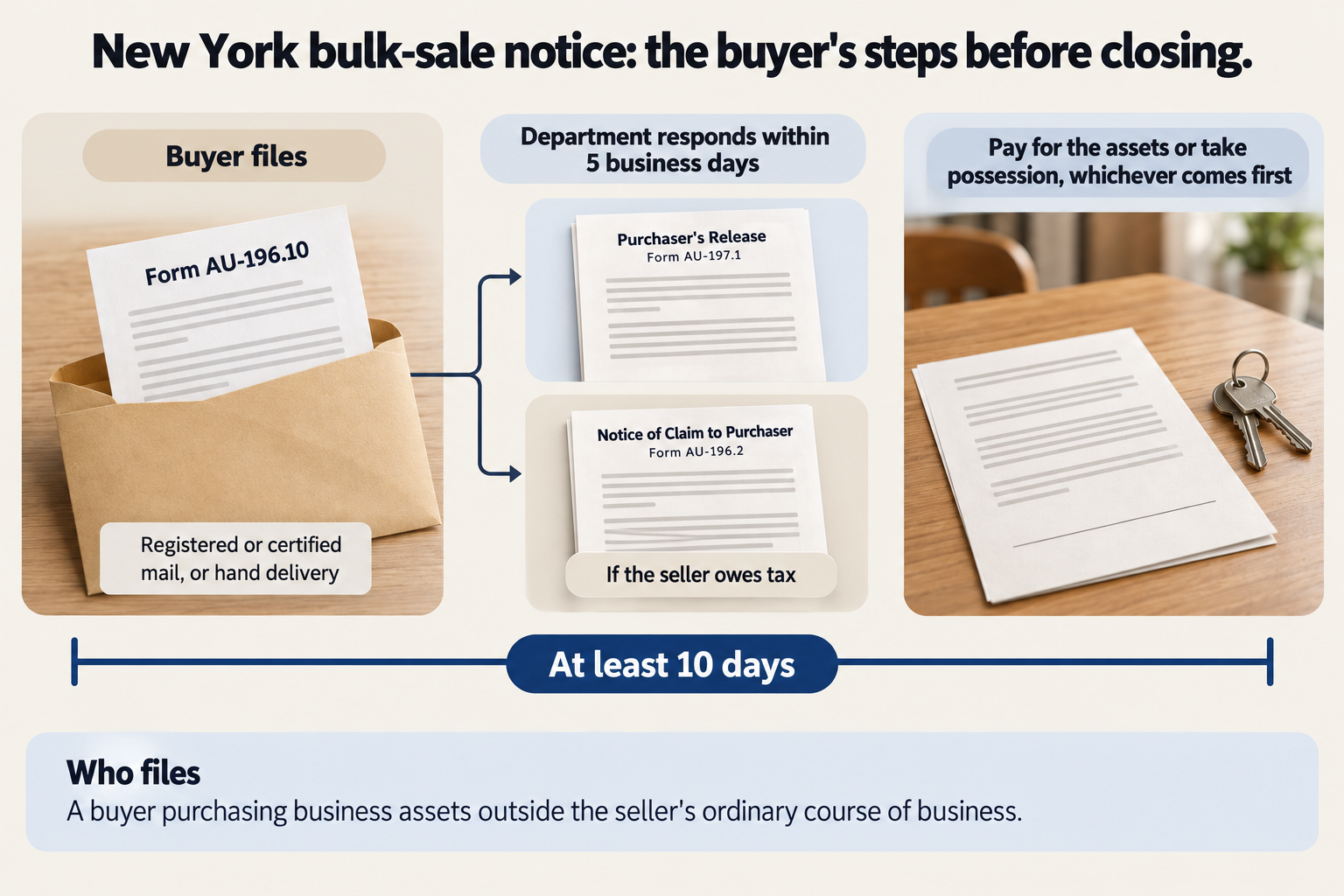 A New York buyer files Form AU-196.10 at least 10 days before paying for the assets or taking possession, and the Department responds within 5 business days.
The choice between an asset purchase and a stock purchase changes who keeps which risk, and it’s worth understanding before you negotiate either document.
Counsel should review the deal before you sign the letter of intent, and at the absolute latest before you sign the purchase agreement. The best calls we get come from buyers before they sign, not after closing.
| Deal stage | Document signed | Who leads | Lawyer’s role |
|---|---|---|---|
| Listing | Listing agreement | Broker and seller | Review the listing agreement to explain your obligations and promises to the broker, so there are no surprises. |
| Offer and negotiation | Offer or letter of intent | Broker drafts; buyer and seller negotiate | Reviews and negotiates the LOI before you sign. LOIs can be “binding” or “non-binding,” and deposits may be negotiated as “refundable” or “non-refundable.” Ask your attorney to carefully review the LOI with you before you sign |
| Due diligence | NDA, document requests | Buyer, seller and both counsel | Coordinates the legal review of leases, contracts and liabilities. |
| Closing | Asset or stock purchase agreement | Both sides’ counsel | Drafts or negotiates the agreement; at the latest, reviews it before signature. |
An LOI isn’t risk-free just because the top of the page says non-binding. Know what happens if you walk away before you sign, since some terms can’t simply be renegotiated later, and which provisions are actually binding is itself a term to check.
Before you sign an LOI, check:
If you want the full list of terms for your deal, we’ve written buyer’s guides for New York and Florida.
One of the costliest mistakes we see is spending real money drafting a purchase agreement before buyer and seller agree on the basic terms. A signed LOI first can save a seller thousands of dollars in legal fees down the line, which raises the next question: what does any of this actually cost?
| Adviser | How the fee is set | What it buys |
|---|---|---|
| Business broker | Commission set in the listing agreement; the amount varies | Marketing, buyer screening and introductions. |
| Business lawyer | Hourly, flat fee or retainer, depending on the matter | Document review, negotiation, legal guidance, and closing work |
| CPA or tax advisor | Hourly or project fee | Tax-structure advice |
| Lawyer For Business | Deal fees depend on the transaction and are discussed at a consultation | A review of your deal documents and a legal plan built around what the sale or purchase actually needs |
Our new-client consultation runs 45 minutes, covers buying or selling a business, and costs $350 plus nominal credit card processing fees, as of October 1, 2026.
The purchase price alone doesn’t set the legal fee. A $1 million business sale can be relatively straightforward, and a $400,000 transaction can become surprisingly complicated, which is why the matter’s complexity, not its size, is what drives the cost.
If you compare legal work quotes, be sure to understand and compare the scope, not just the number. A quote of $2,500 can look better than a quote of $7,500, until you learn the first attorney is only reviewing the purchase agreement, not the whole deal, and you’re not completely covered.
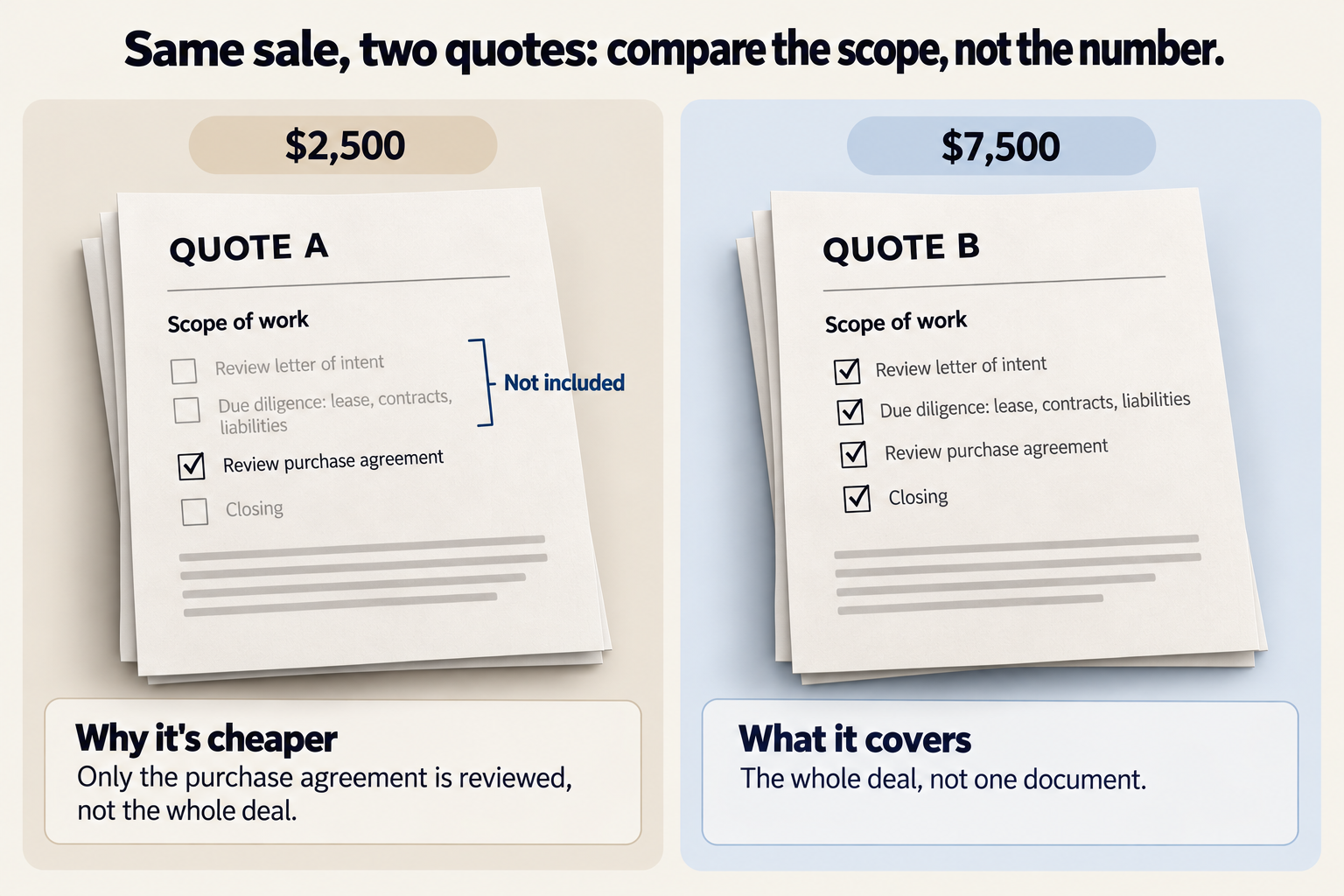 A $2,500 quote can look better than a $7,500 one until you see it covers only the purchase agreement, not the whole deal.
At Lawyer For Business, our fees for a business purchase or sale depend on the matter and are discussed at your consultation. We don’t publish a flat number for deal work, because the work varies, but we pride ourselves on efficient legal representation and quick turnaround timelines. The next question most owners ask is who actually does that work.
Andrea A. Willis is licensed in both New York and Florida, and our firm represents buyers and sellers in both states when a broker is part of the deal.
On the New York side, we draft and respond to letters of intent, prepare purchase agreements with seller-protective terms, structure indemnities, representations and warranties, and coordinate with the buyer’s counsel through closing.
In Florida, we represent both buyers and sellers, from a small business purchase to a more complex equity sale, reviewing the asset-versus-equity structure, running due diligence on contracts, leases and licenses, and drafting the purchase agreement itself.
“For more than a decade, I’ve helped buyers negotiate Letters of Intent for business acquisitions in New York and Florida. An LOI is often treated as a simple outline of the deal, but the terms you agree to at this stage can significantly affect your rights, leverage, and costs throughout the transaction. For example, I recently worked with a buyer who was acquiring an established business. We identified issues in the proposed deal structure before the buyer signed the LOI, including how the purchase price would be allocated, what liabilities the buyer would assume, the scope of the due diligence period, and the protections the buyer would have if the seller’s representations did not hold up. Addressing those issues early gave the buyer an opportunity to negotiate protections before the terms became part of the definitive purchase agreement.
I also work alongside your outside accountant and financial advisors when tax, valuation, or financial questions arise during due diligence. I don’t try to replace those professionals. Instead, I make sure the legal structure of the transaction works with their advice and that important business, tax, and legal issues are addressed before you commit to the purchase.
…help you understand what you are buying, identify risks before they become expensive problems, and structure the transaction so you are protected from the outset.”
Our process looks the same in both states:
We represent buyers and sellers throughout Cocoa Beach, Brevard County and across Florida, and across New York, including Buffalo, Albany, Rochester and New York City. This includes Melbourne, Viera and Palm Bay, as well as remotely throughout Florida.
Consultations are fully virtual, conducted by either phone call or video call, and you can handle the entire matter online without setting foot in an office.
If a broker has handed you paperwork and you want a second set of eyes before you sign, book a consultation for your state.
You want a business lawyer who understands how both buyers and sellers approach a transaction. Experience with business deals matters more than the practice-area label on their website.
Because we represent both sides in business acquisitions, we understand what each party is looking for, where negotiations typically get difficult, and where important protections can be overlooked. Andrea A. Willis is licensed in both New York and Florida.
Florida treats anyone who negotiates the sale of a business for pay as a “broker” under Chapter 475 of the Florida Statutes, and requires an active license to operate as one. At the federal level, the Securities Exchange Act’s “M&A broker” exemption can relieve a broker from SEC broker-dealer registration when selling a privately held company to a buyer who will control and run it.
That federal exemption has limits. It doesn’t cover a broker who holds the parties’ funds or securities, provides financing, or represents both sides without clear written disclosure and consent, and neither rule tells you how the broker in your own deal is actually set up, so the listing agreement, not the label, is what to read.
It depends on how the fee is structured. Our firm offers hourly billing, flat fees for specific projects, and retainer arrangements, and discusses which fits your matter at your consultation.
With hourly billing, you pay the same rate for calls and emails as for drafting work.
The information you obtain at this site is not, nor is it intended to be, legal advice. Contacting us does not create an attorney-client relationship. Please do not send any confidential information to us until such time as an attorney-client relationship has been established.