A $400 hourly quote looks high until you see what lawyers near you charge. It looks low once you learn what a single hour can include.
A Manhattan contracts lawyer, a Melbourne general practitioner, and a franchise specialist serving Florida businesses all bill by the hour. None of them are pricing the same risk, and the number alone won’t tell you whether your matter even suits hourly billing.
Clio’s 2025 Legal Trends data puts the average lawyer’s hourly rate at $426 in New York and $353 in Florida, against a $349 national average. A $400 quote sits inside the reported range in New York, and above the reported average in Florida.
At Lawyer For Business, we charge $350 an hour, as of October 2026, and we flat-fee only one kind of work: forming your legal entity. Everything else, including a business purchase, gets billed hourly or quoted at your consultation.
This page walks through what New York’s and Florida’s own fee rules test, and when a flat fee beats hourly for the work you have. It also covers what a retainer, outside counsel, and a per-project quote each cost, how a business purchase gets priced, and exactly what we charge for each one, state by state.
Neither state publishes a maximum rate. What New York and Florida publish instead is a test, applied after the fact, for whether a fee charged was a reasonable one.
New York’s Rules of Professional Conduct bar a lawyer from charging an excessive or illegal fee. A fee is excessive when a reasonable lawyer, reviewing the same facts, would reach a definite and firm conviction that it is. The rule weighs:
Florida’s Rules Regulating The Florida Bar bar a lawyer from charging an illegal, prohibited, or clearly excessive fee. A fee is clearly excessive when a lawyer of ordinary prudence, reviewing the same facts, would reach a definite and firm conviction that it exceeds a reasonable fee to the point of clear overreaching or an unconscionable demand.
Within either state, the average hides a wide spread. Clio’s 2025 data puts practice-area rates anywhere from $159 to $608 in New York, and from $209 to $642 in Florida.
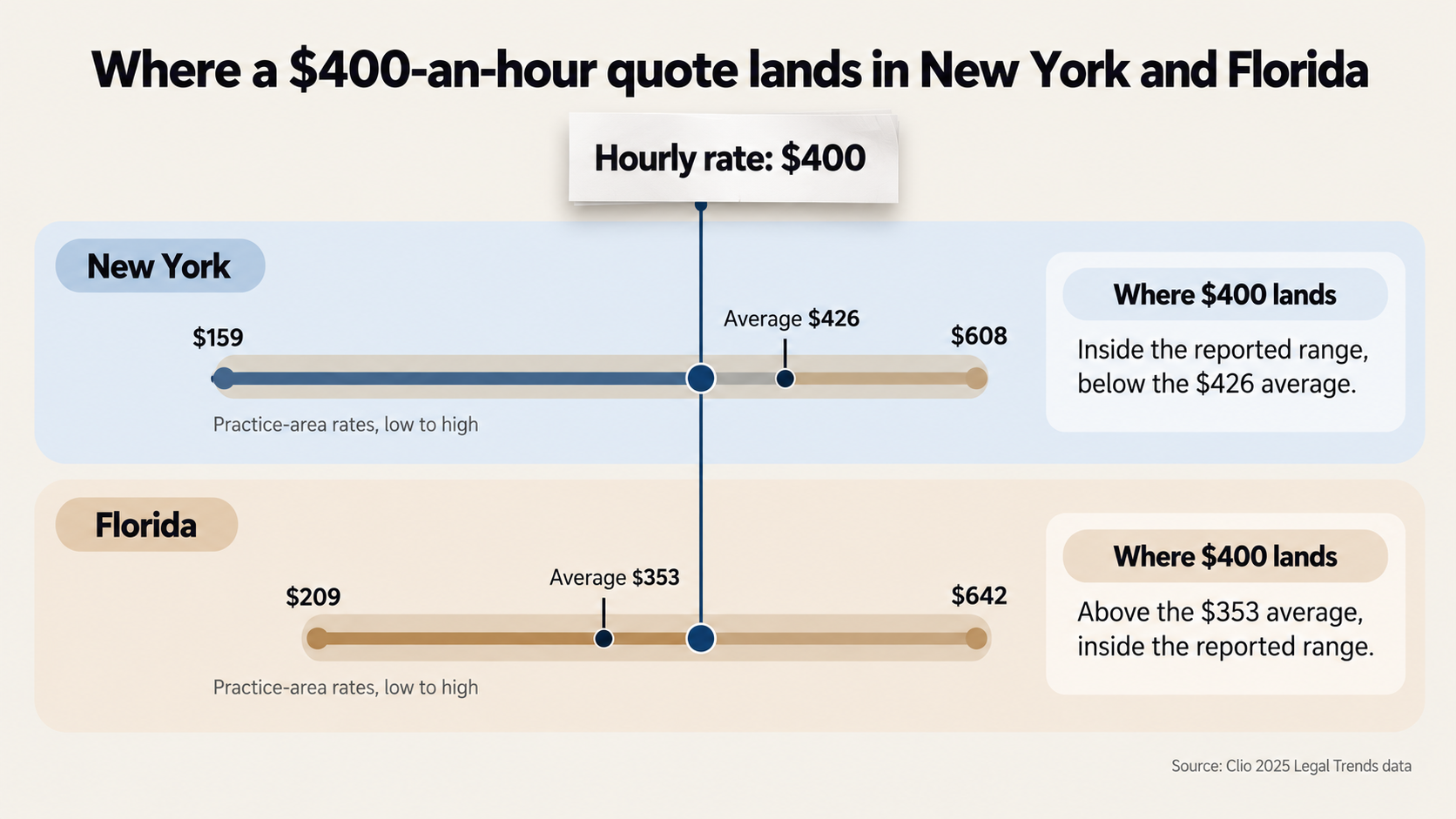
Both tests judge a fee after it’s charged. The better question to ask beforehand is which billing structure fits the work at all.
| Billing structure | How the price is set | Fits work that is | What the bill covers | Ask before agreeing |
|---|---|---|---|---|
| Hourly | The rate multiplied by the time logged | Open-ended, likely to change, or hard to scope in advance | Calls, emails, drafting, and follow-up, all billed at the same rate | Whether you can start or stop the work whenever you choose |
| Flat fee | One agreed price for a defined scope of work | Defined, repeatable, with a known deliverable | Everything the agreed scope describes, and nothing outside it | What exactly the scope includes, and what happens if the matter grows past it |
Most business lawyers bill hourly, by flat fee, or by retainer. Which one applies depends on the matter, not the lawyer’s general practice. Comparing two quotes by their number alone hides the real difference: the structure decides what you’re paying for, and the scope decides what’s left out.
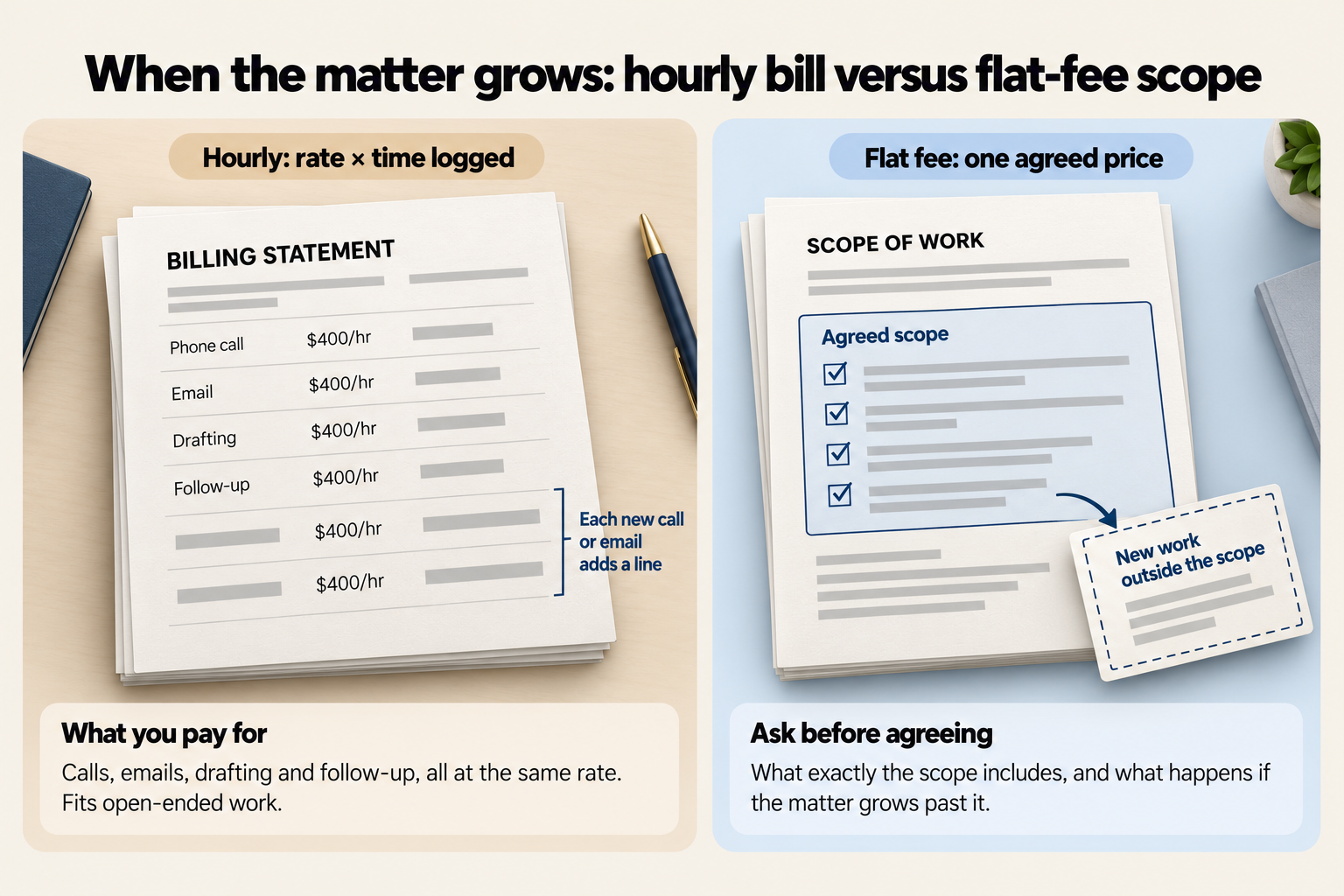
That comparison gets harder once the work shifts from a single matter to an ongoing relationship, which is the more common situation for a small business with a steady stream of contracts and questions.
| Arrangement | What you pay for | Suits | Watch for |
|---|---|---|---|
| Retainer / advance deposit | Funds held against future work, drawn down as it’s used | Owners who expect recurring but unpredictable work | New York bars a nonrefundable retainer fee; the agreement must say in plain language when the fee is earned and how it’s calculated |
| Outside general counsel | A standing relationship instead of a single engagement | Businesses that want in-house-style access without adding payroll | Whether the arrangement reduces what you’d otherwise spend on one-off engagements |
| Legal plan subscription | A listed set of services for a set periodic payment | Owners who want predictable, budgeted legal costs | Whether the services you need are on the list; Florida law defines this type of arrangement by statute |
| Pay per project | A separate price or quote for each matter as it comes up | Owners with occasional, distinct needs | Re-explaining context every time, since there’s no ongoing relationship |
Whichever arrangement you pick, put it in writing. A representation agreement that sets out the scope and the fee, and a way to check the billed work against both, protects you as much as it protects your lawyer.
We offer outside general counsel in both New York and Florida: corporate and business law, compliance, contract work, and day-to-day guidance, without adding another salary to your payroll. The fee for that work depends on the matter and gets set at your consultation.
If a retainer specifically is what you’re weighing, our retainer guide covers what one buys in more detail than this page can.
All four of these assume ongoing work. A business purchase is a single, usually larger matter, and it tests the flat-fee-versus-hourly question harder than anything else an owner buys.
The purchase price alone doesn’t set the legal fee. A $1 million sale can be straightforward if the business is clean and the parties agree on structure early. A $400,000 deal can turn complicated fast if the lease can’t transfer, the inventory needs recounting, or the seller’s numbers don’t match the tax returns.
Before you accept a quote, ask:
Compare two quotes by what they cover, not what they cost. A $2,500 quote that only reviews the purchase agreement isn’t more affordable than a $7,500 quote that reviews the whole deal if it leaves you exposed everywhere else.
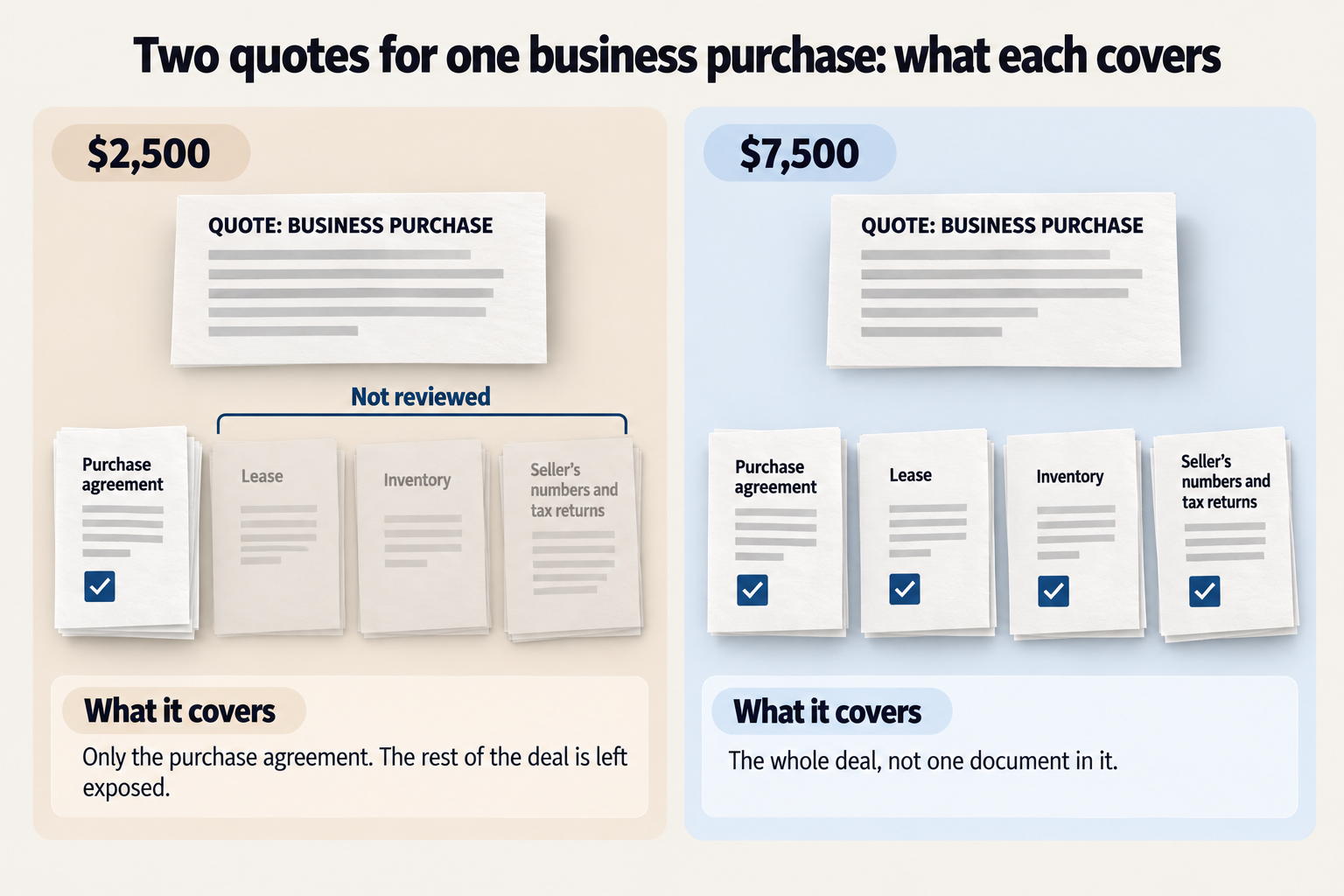
At Lawyer For Business, our fees for a business purchase or sale depend on the matter and get set at your consultation. We don’t publish a flat number for deal work because the work varies.
Getting advice early usually costs less than getting it late. It can save time, legal fees, and the surprises that show up after closing.
Andrea A. Willis explains what she looks for before a buyer signs:
For more than a decade, I’ve helped buyers negotiate Letters of Intent for business acquisitions in New York and Florida. An LOI is often treated as a simple outline of the deal, but the terms you agree to at this stage can significantly affect your rights, leverage, and costs throughout the transaction.
For example, I recently worked with a buyer who was acquiring an established business. We identified issues in the proposed deal structure before the buyer signed the LOI, including how the purchase price would be allocated, what liabilities the buyer would assume, the scope of the due diligence period, and the protections the buyer would have if the seller’s representations did not hold up.
The goal is not simply to get your deal signed. It is to help you understand what you are buying, identify risks before they become expensive problems, and structure the transaction so you are protected from the outset.
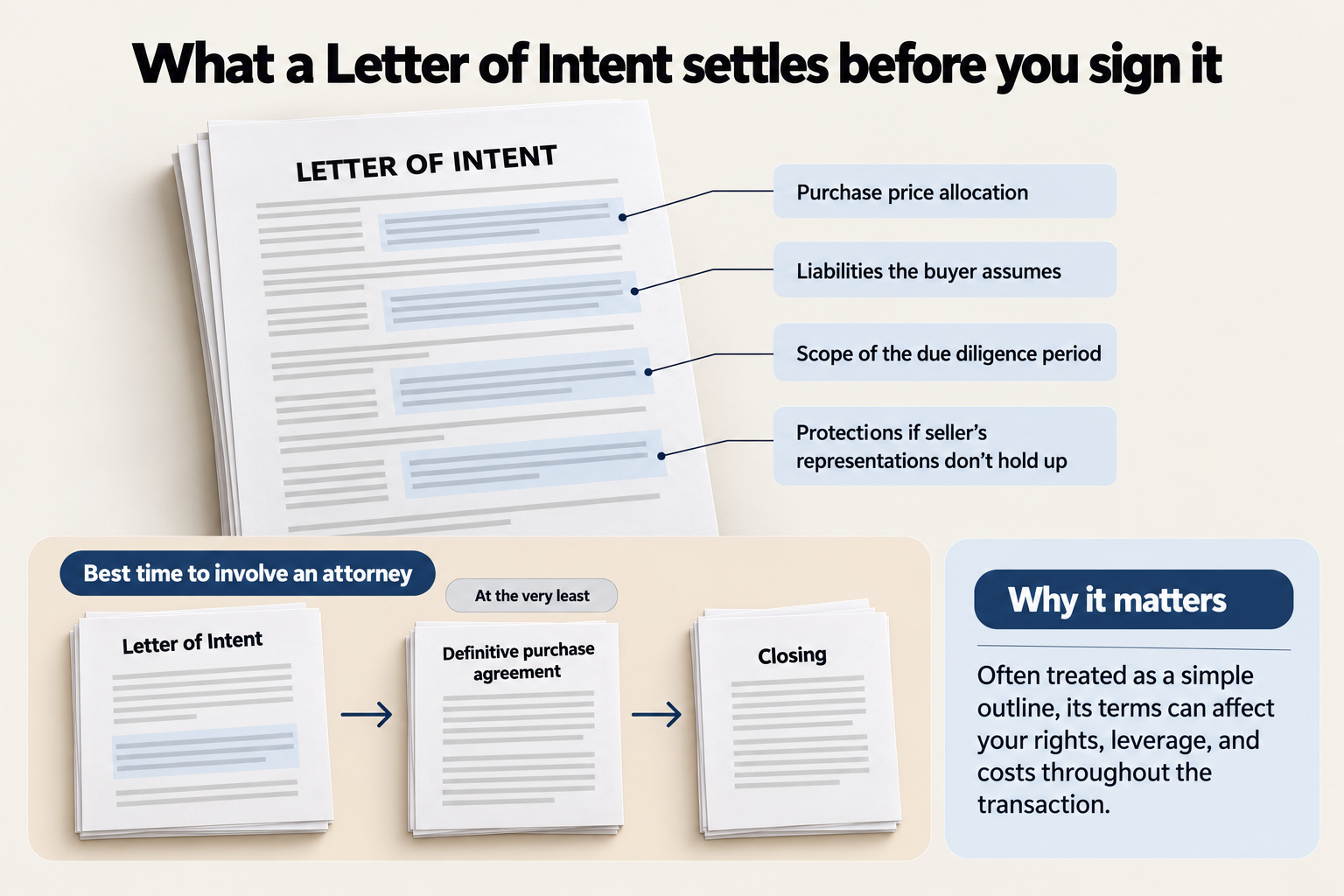
Every number in this section gets set after a conversation. A purchase is rarely one job: it combines due diligence, negotiation, and drafting, and only a consultation tells you how much of each yours needs.
For a closer look at how those fees break down, see our guides to what a business sale lawyer costs in New York and in Florida.
The rates and flat fees below apply as of October 2026, broken down by state.
| Lawyer For Business service | How it is billed | Price, as of October 2026 | What it includes |
|---|---|---|---|
| Hourly work | By the hour | $350 an hour | Calls, drafting, review, and everything else, billed at the same rate |
| New-client consultation | A flat 45-minute session | $350, plus a nominal credit card charge | A separate fee from the hourly rate; covers buying or selling a business, contracts, employees, leases, and franchise questions |
| New York LLC package | Flat fee | $2,569.82 | Filing, a custom operating agreement, the mandatory publication requirement, EIN instructions, and attorney oversight (full list below) |
| Florida LLC package | Flat fee | $931 | The Articles of Organization filing fee, a certified copy, a custom operating agreement, and all legal fees for drafting and forming the LLC (full list below) |
| Deal and outside counsel work | Hourly or quoted | Set at your consultation | Depends entirely on the matter; no published flat number |
The New York package includes:
The Florida package includes:
Consultations are fully virtual, by phone or video, so you can handle the whole conversation without an office visit. Andrea A. Willis is licensed in both New York and Florida, so the same consultation works whichever state your business is in.
A rate tells you what an hour costs, while a structure tells you what you’re paying for, so check both before you accept any quote.
Book a 45-minute consultation for $350, by phone or video, for either state.
Why are lawyers expensive?
Legal fees look high next to doing nothing, but they’re usually small next to the cost of defending a dispute that a cheaper, earlier conversation could have avoided.
You can also keep your own bill down. Write down what’s wrong, its impact, and your deadline before you contact your attorney, answer promptly, and keep a shared log of open issues instead of re-explaining them each time.
Are flat-fee lawyers worth it?
Yes, when the work is defined and the price states exactly what is, and isn’t, included.
A flat-fee formation package, for example, can fold in a predictable cost like New York’s mandatory publication requirement, so it’s budgeted in rather than a surprise later.
Should I hire a lawyer when buying a business?
Yes, and the timing matters more than most buyers expect.
The best time to involve a business attorney is before you sign the Letter of Intent, when there’s still room to structure the deal and negotiate terms in your favor. At the very least, have an attorney review the deal before you sign the definitive purchase agreement.
Who can I call with quick legal questions?
If quick questions come up often, you’re usually better served by an ongoing arrangement, like a retainer or outside general counsel, than by a single call each time. See our full breakdown of what a lawyer on retainer handles for what that covers.
The information on this page is not, and is not intended to be, legal advice. Contacting us does not create an attorney-client relationship. Please do not send any confidential information to us until an attorney-client relationship has been established.