You agreed on a price. In Buffalo, that’s the part almost anyone can do: a broker, a handshake, a term sheet drafted over lunch.
The deal itself gets decided later, in documents most first-time buyers haven’t seen yet. An agreed price is not an agreed deal. The purchase agreement is where liability, leases, and consents actually get decided, and a broker and a lawyer aren’t doing the same job: a broker finds and negotiates with buyers, while a lawyer handles the legal consequences, the protections, the agreements, and the risk allocation a price tag never covers.
This page walks a New York small-business purchase from the signed letter of intent to closing: the two state clocks that start running before you pay, what legal due diligence has to find, what the asset purchase agreement decides, and how a Buffalo buyer finds a lawyer for a deal under \$2 million. Your own attorney should see the deal before you sign the letter of intent.
A small-business purchase in New York moves through three stages, and each one has its own paperwork and its own hands on it.
| Stage | What gets signed or filed | Who handles it | New York clock |
|---|---|---|---|
| Offer and negotiation | A letter of intent | The broker drafts it; buyer and seller negotiate it; your attorney reviews and negotiates it before you sign | None due yet |
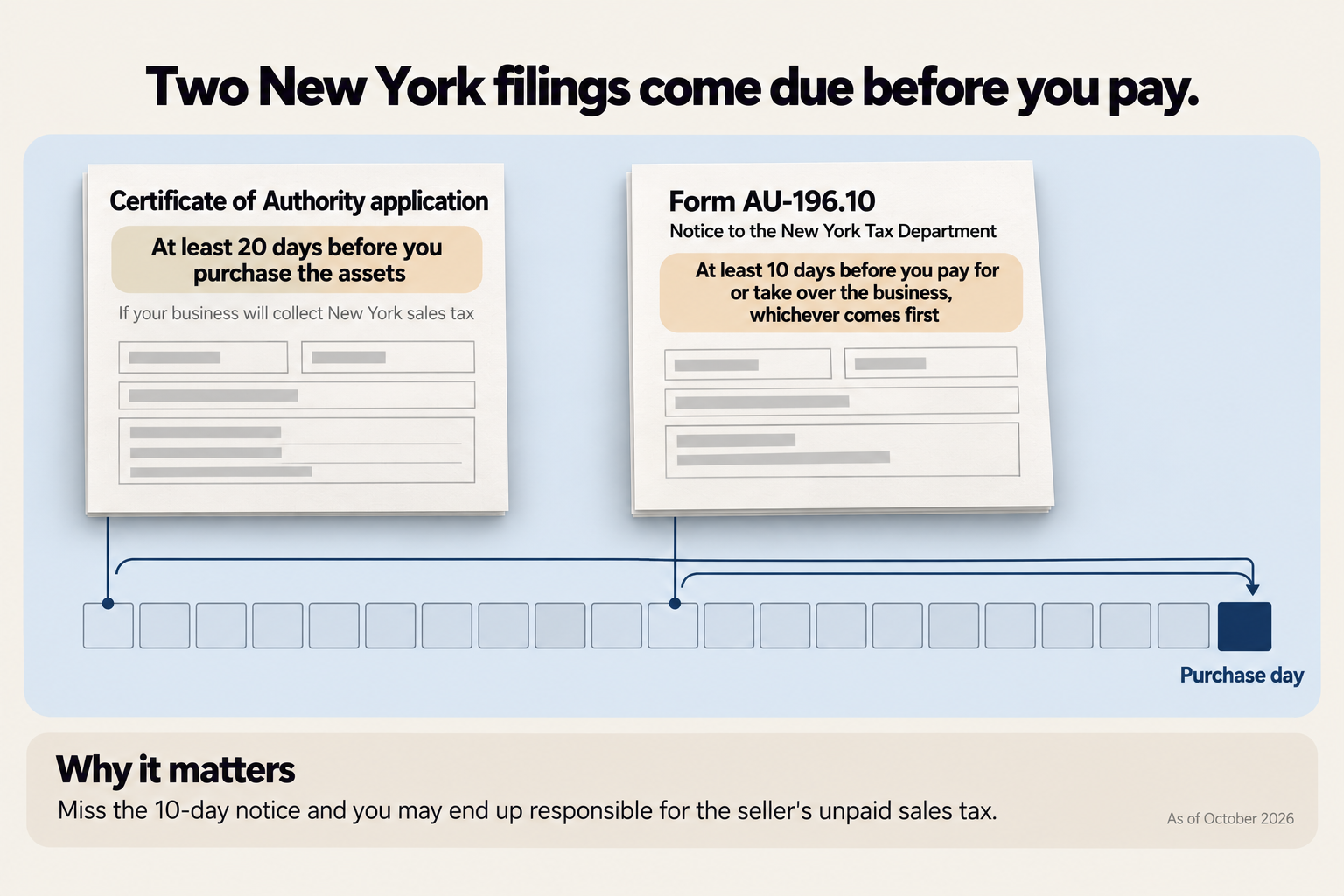
| Due diligence | NDA and document requests | Buyer, seller, and both sides’ counsel; your attorney coordinates the legal review of leases, contracts, and liabilities | If your business will collect New York sales tax, apply for a Certificate of Authority at least 20 days before you purchase the assets, as of October 2026 |
| Closing | The asset or stock purchase agreement | Both sides’ counsel; your attorney drafts or negotiates it, and at the latest reviews it before you sign | Notify the New York Tax Department on Form AU-196.10 at least 10 days before you pay for or take over the business or its assets, whichever comes first, as of October 2026, or you may end up responsible for the seller’s unpaid sales tax |
How long this takes depends entirely on what the deal needs. A straightforward purchase with a cooperative landlord and clean books can move quickly and keep legal costs low. A deal with a lease to renegotiate, a lender in the mix, or liabilities to sort through usually needs more steps, which means more time and more legal work.
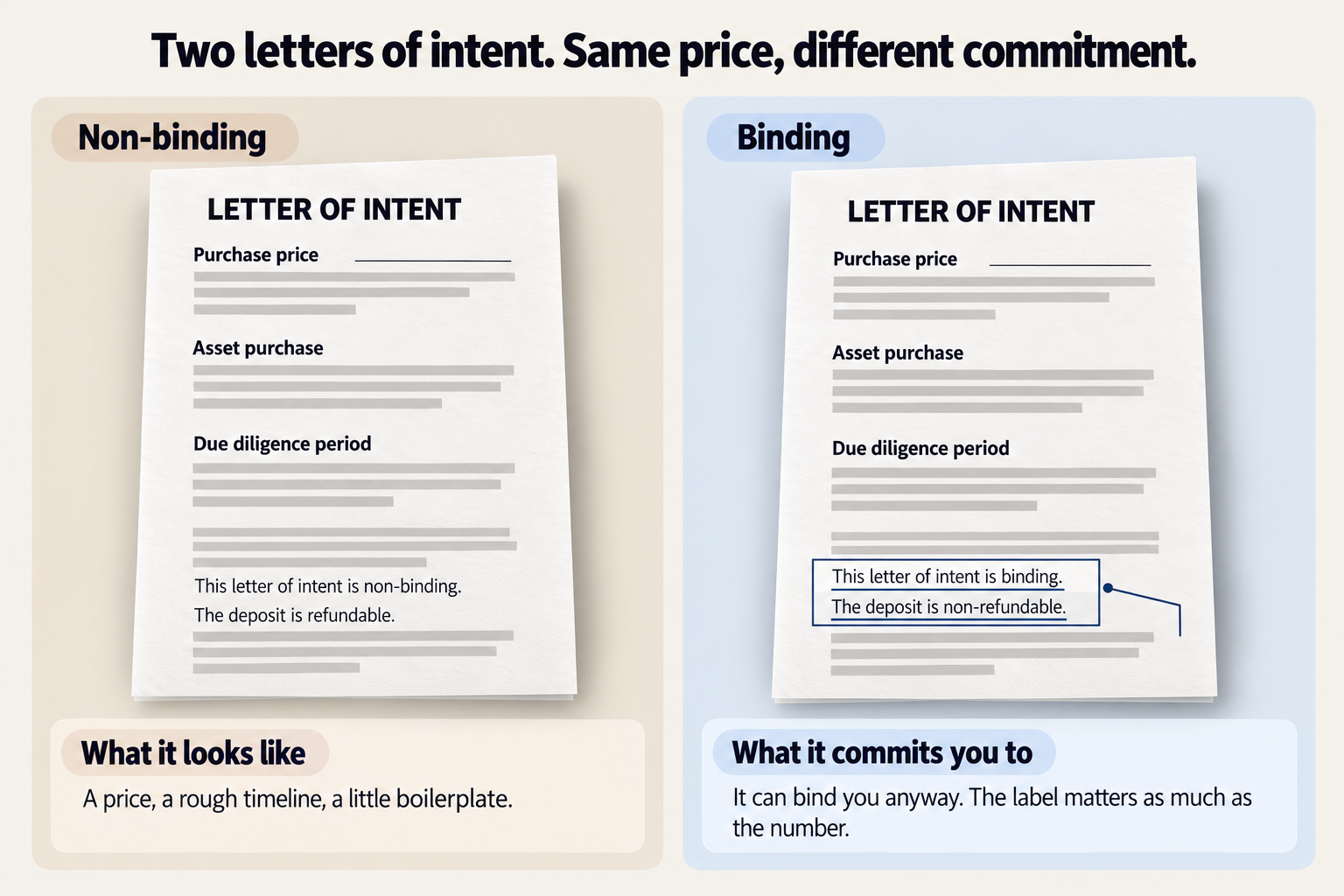
A letter of intent reads like a formality: a price, a rough timeline, a little boilerplate. It can bind you anyway. New York lets an LOI be binding or non-binding, and the deposit inside it can be negotiated as refundable or non-refundable, so the label matters as much as the number.
Before you sign, check four things:
We recommend involving a business attorney before you sign the letter of intent, while there’s still room to structure the deal and negotiate these terms on your own terms. At minimum, have an attorney review the transaction before you sign the definitive purchase agreement.
Most buyers wait until they’re ready to sign the purchase agreement to call a lawyer. By then, the terms in the LOI may already be locked in, which makes problems harder, and often more expensive, to fix.
Our guide to negotiating a New York letter of intent walks through each of these terms in more detail.
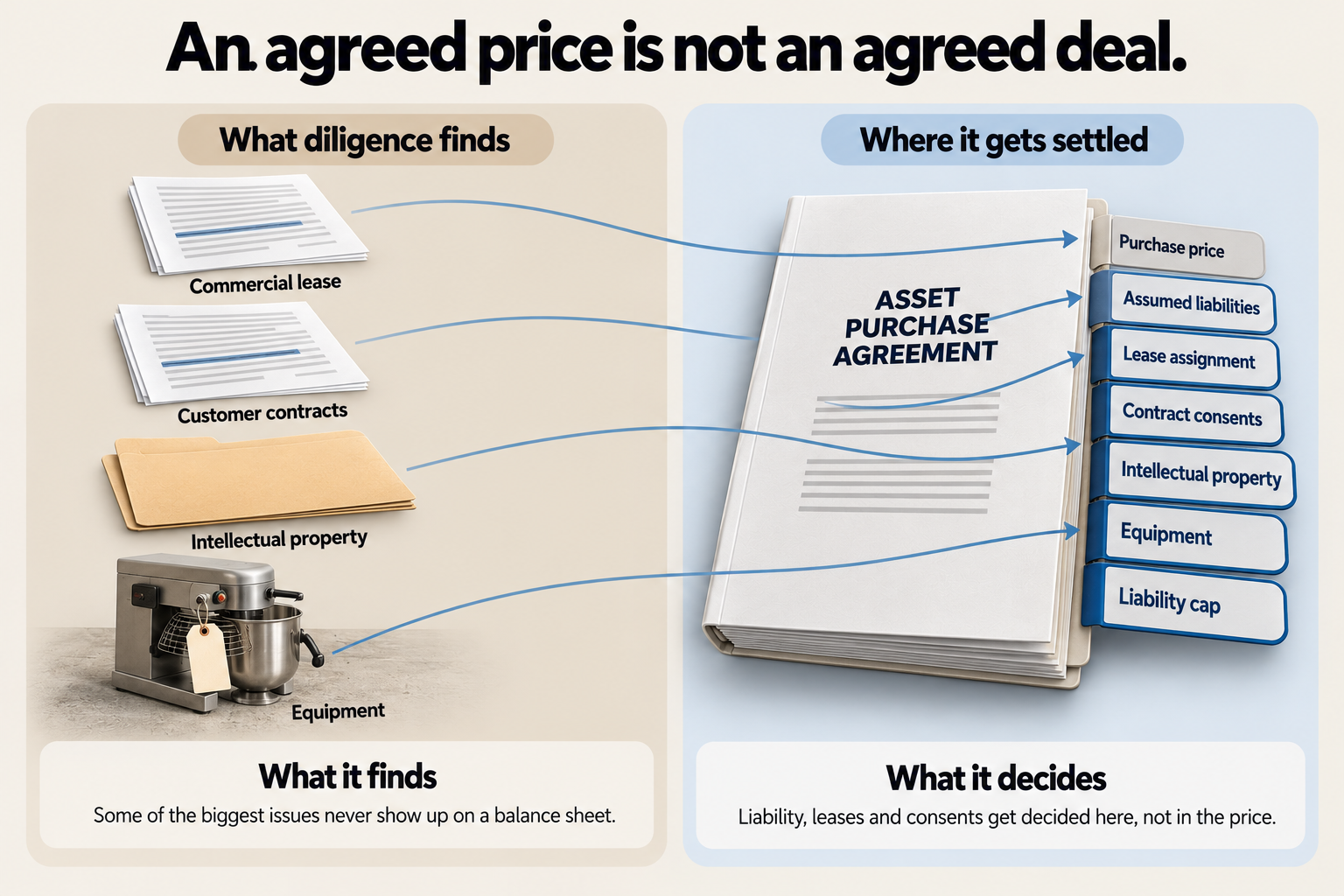
Due diligence exists to show you exactly what you’re buying before money changes hands, not to kill the deal. Some of the biggest issues never show up on a balance sheet. Price is almost never what delays a closing.
What usually does: whether the commercial lease can be assigned to you, whether key customer contracts need a third party’s consent to transfer, whether the seller actually owns the intellectual property the business relies on, and whether the equipment on the floor was ever properly identified in the agreement. Finding any of these before closing gives you options. Finding one after closing usually gives you an unexpected bill.
| Question | Why it matters at closing | Who checks it |
|---|---|---|
| Can the lease be assigned to you? | Lease issues are one of the most common reasons buyers end up renegotiating a deal | Your attorney reviews the lease and the landlord’s consent requirements |
| Do key customer contracts transfer without a third party’s consent? | A contract that can’t transfer walks out the door with the seller | Your attorney |
| Does the seller actually own the intellectual property? | Ownership gaps surface after closing, when there’s no leverage left to fix them | Your attorney |
| Was the equipment on the floor properly identified in the agreement? | Equipment left out of the agreement may not be equipment you actually own afterward | Your attorney |
| Are there liens filed against the assets? | A lien can follow the assets to you as the new owner | A UCC search against the debtor’s name at the New York Department of State, $25 per name searched, as of October 2026, requested on Form UCC-11 |
| What does the seller’s NDA cover? | It controls what you’re allowed to do with the records you’re about to see | Your attorney, before any records change hands |
Your attorney coordinates this legal review: lease, contracts, liabilities, intellectual property. Your CPA reviews the financial records separately. Your broker typically isn’t involved at this stage.
Diligence finds the problems. The purchase agreement is where they get settled. Whether you structure the deal as an asset purchase or a stock purchase changes who keeps which risk, and it’s worth understanding the difference before you negotiate either document, a question our asset purchase versus stock purchase guide covers in depth.
Discuss the structure with your attorney and your tax advisor before you sign anything. They answer different questions: one manages your legal risk, the other your tax bill.
The agreement is also where liability gets capped if a problem surfaces after closing.
A single business purchase in New York typically involves several sets of legal documents, not just the purchase agreement itself. Depending on the deal, the full set can include:
If the seller’s attorney drafts this document set, assume it’s written to protect the seller. Involve your own attorney even when the documents are already drafted, because a well-drafted contract and a contract drafted for you are not the same thing.
If you’re having trouble finding a lawyer who seems genuinely interested in a deal this size, you’re not alone in Buffalo. What matters less is the size of the firm, and more one specific qualification.
You need a business lawyer with real transaction experience, not simply one whose website happens to use the words “business law.” Buying a business requires an attorney who understands how deals are structured, where buyers face risk, and how to protect your interests throughout the transaction.
Two things narrow the search: what to look for, and where to look if you don’t have a lead.
A seller staying on as a minority shareholder with voting rights, a spouse staying on as an employee, and the seller financing part of the price is one kind of deal. A retiring owner selling their half of the business to their existing partner is a different one, and the legal work isn’t close to the same size.
| Deal shape | What drives the legal work |
|---|---|
| Seller stays on as a minority shareholder with voting rights, spouse stays on as an employee, seller and spouse finance part of the price | Several documents have to work together: equity terms, an employment arrangement, and a loan, on top of the purchase agreement itself |
| A retiring owner sells their half of the business to their existing partner | Often a simpler document set and less legal work |
At our firm, deal fees depend on the size of the business and the scope of the work, and we work with quick turnaround times. We don’t publish a flat number for deal work, because the work varies too much from one purchase to the next. What a given deal will cost gets discussed at your consultation.
When you compare quotes, compare scope, not just the number. A quote of $2,500 can look better than a quote of $7,500, until you learn the cheaper one only covers the purchase agreement itself, not the rest of the deal.
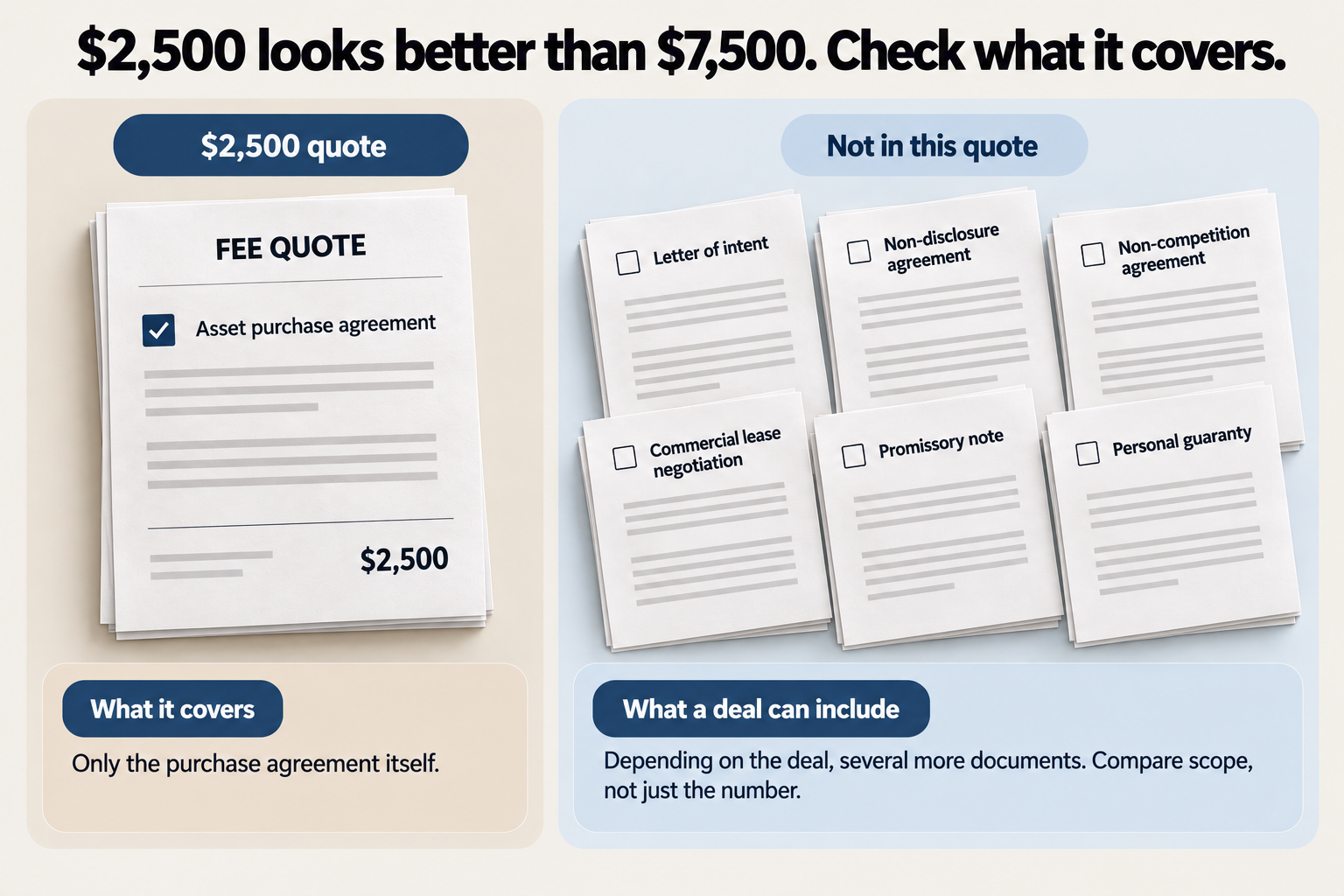
The purchase price alone doesn’t decide the fee either. A $1 million business sale can be relatively straightforward. A $400,000 purchase can turn out to be the more complicated one. Ask what legal work your deal actually requires, and if a quote is a flat fee, ask what’s included.
You now know what the deal involves and what to look for in a lawyer. Here’s how we handle a purchase like this out of Buffalo.
We represent buyers and sellers across New York, including Buffalo, Albany, Rochester, and New York City. We work with first-time buyers and experienced owners who want a transaction structured cleanly and professionally. Andrea A. Willis is a Florida Bar and New York bar member in good standing, and consultations are fully virtual, by phone or video, so the entire matter can be handled without an office visit.
A purchase typically moves through four steps:
“When buying a small business in New York, it’s important to look beyond the asking price and understand exactly what you’re getting.
“I recently worked with a buyer who wanted to purchase a local deli that had been a neighborhood institution for years. The seller had placed a significant portion of the purchase price on the value of the equipment. During due diligence, however, we discovered that much of the equipment was leased rather than owned, and several pieces were in poor condition.
We took that information back to the negotiating table and were able to significantly reduce the purchase price. The deal still closed, and my client was thrilled with the outcome.
This is a great example of why due diligence is so important when buying a business. Taking the time to ask the right questions and uncover potential issues can make a real difference in the final deal. My goal is to help clients make informed decisions, protect their investment, and feel confident that the business they’re buying is worth what they’re paying for it.” Andrea A. Willis
If you’re working through a purchase like this, our New York business purchase and sale practice covers the full transaction. The New York Business Consultation runs 45 minutes for \$350, as of October 1, 2026, and covers guidance on buying or selling a business. You can book a New York Business Consultation here.
The information on this page is not, nor is it intended to be, legal advice. Contacting us does not create an attorney-client relationship. Please do not send any confidential information to us until an attorney-client relationship has been established.