Your website’s footer probably has a link called “Terms of Service” or “Terms & Conditions.” If you built the site yourself, that page likely came from a competitor’s site, a template, or an AI tool, and no one has reviewed it since.
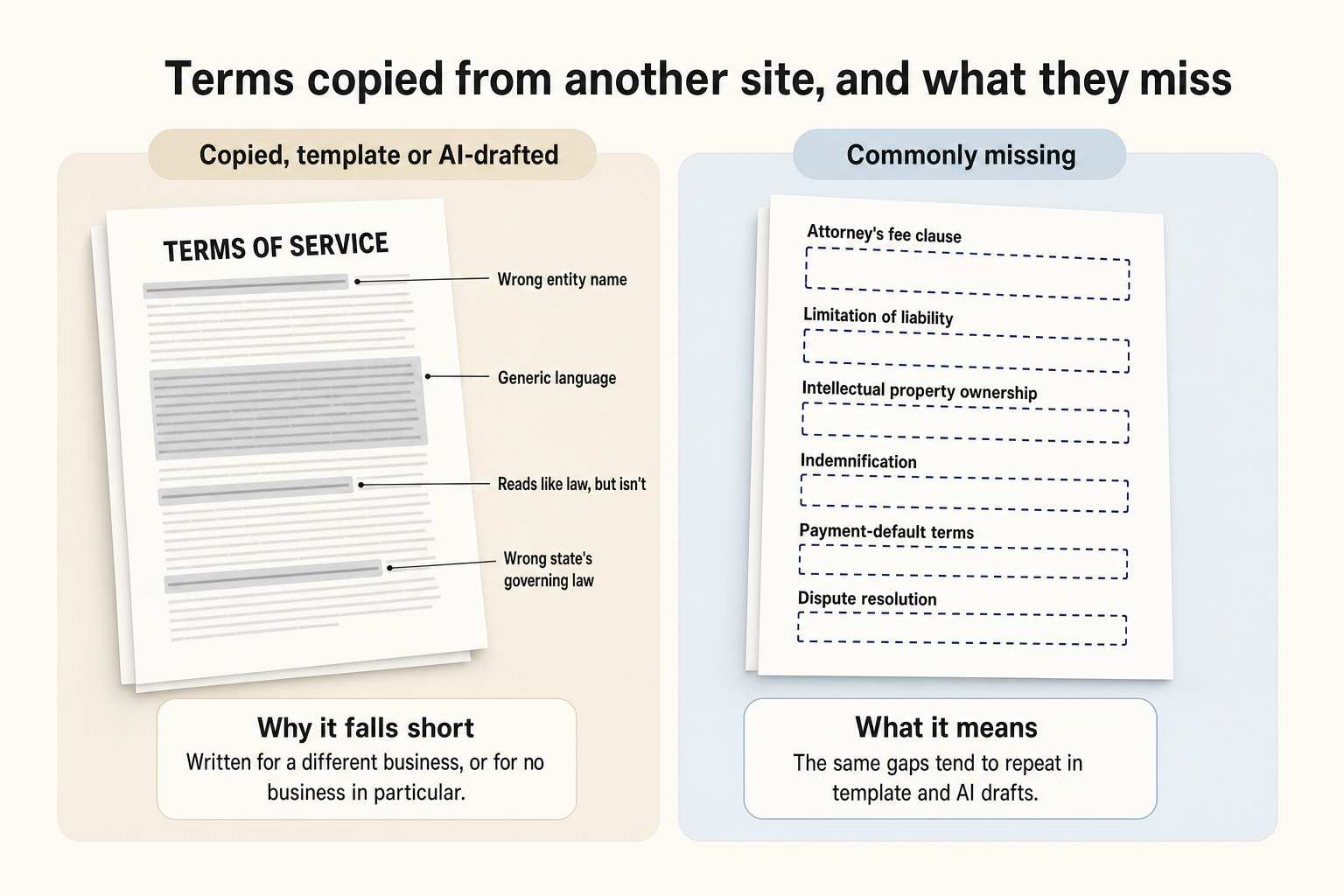 The right page is the one to check: copied terms often have no section at all for these six protections.
Website terms of service, terms of use and terms and conditions are the same document under three common names: the contract between your business and the people who use your site. A business lawyer drafts them around how your site works, not around what another business’s terms say, and Lawyer For Business drafts customer terms and conditions for New York businesses, including those based in Buffalo. The firm’s flat fees cover entity formation and trademarks only, so this is quoted work rather than a priced package.
What follows covers what the document has to address, the New York and federal rules it sits beside, why a copied or AI-written version tends to fall short, and what the work costs.
Terms of service, terms of use, terms and conditions. These are three names for one document: the rules a visitor agrees to by using your site. It covers what they can and can’t do there, what you are and aren’t responsible for, and how a dispute between you gets handled.
Privacy policy. This is a separate document. It explains what personal information your site collects and what you do with it, not what a visitor agrees to by using the site. The two usually sit next to each other in a footer, but they do different jobs and answer different questions.
New York’s State Technology Law gives an electronic signature the same legal effect as a handwritten one, unless another law says otherwise. That’s the general rule behind signing agreements online in New York.
Website terms raise a related but separate question: how a particular site’s design and wording lead a visitor to accept them. That’s a detail a lawyer reviews site by site, not a rule stated once for every business. What’s left to settle is which New York laws that contract has to live alongside, and that depends on what your site does.
The rules below reflect New York law as of October 2026.
| If your site… | New York rule | What it says | Where it’s written |
|---|---|---|---|
| Deals with New York customers | GBL § 349 | Unfair, deceptive or abusive business practices are unlawful. “Abusive” includes conduct that materially interferes with a customer’s ability to understand a term or condition of what you sell | NY General Business Law § 349 |
| Sells auto-renewing subscriptions or continuous services | GBL § 527-a | You must present the renewal terms clearly and get the customer’s affirmative consent before charging a renewal fee | NY General Business Law § 527-a |
| Stores New York residents’ private information | GBL § 899-bb | You must maintain reasonable safeguards for that data, judged against your business’s size, complexity and the sensitivity of what you hold | NY General Business Law § 899-bb |
Which of these apply to your site depends entirely on what your site does. That’s exactly why a document written for a different business, or for no business in particular, usually misses at least one of them.
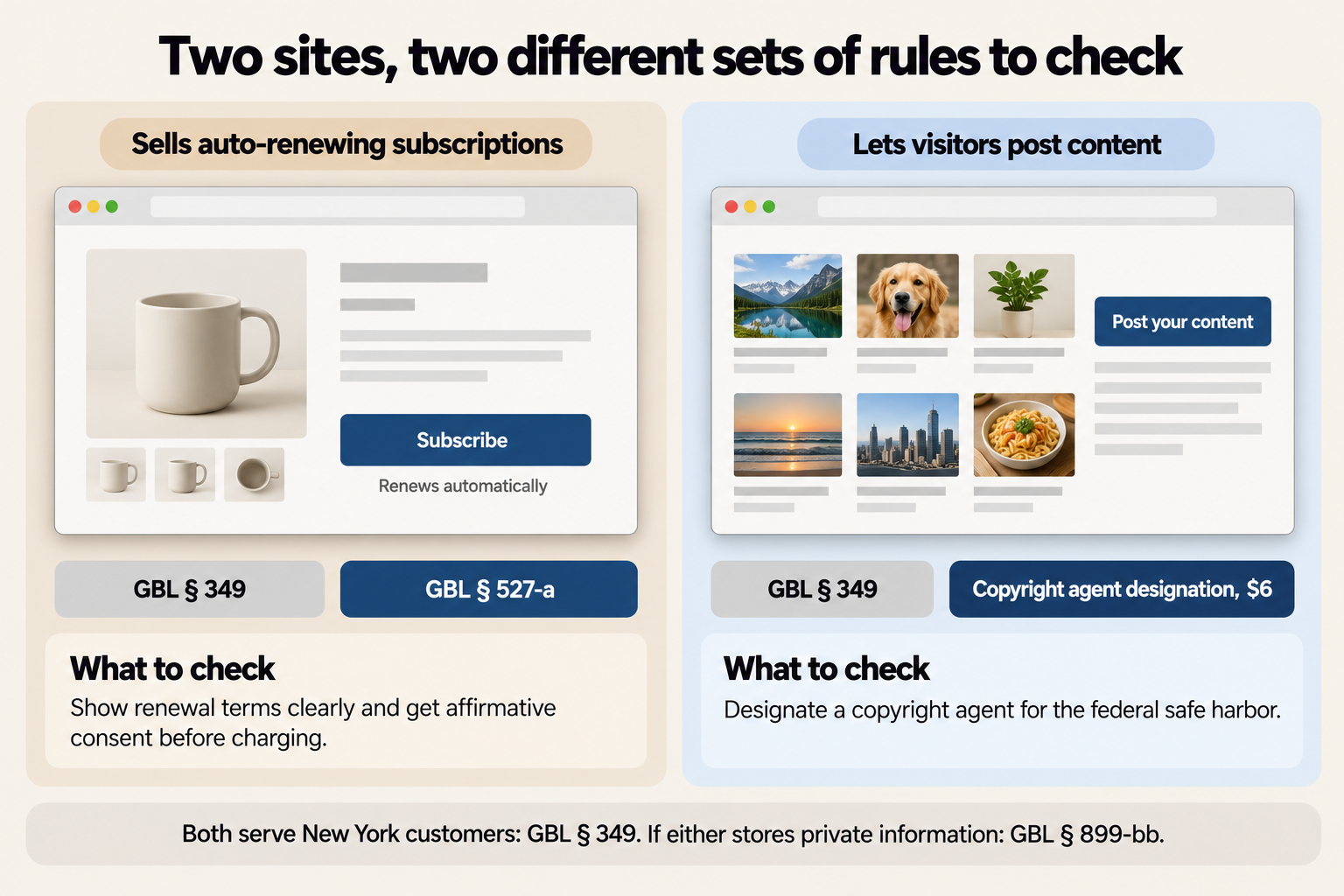 The blue tag is what differs: a subscription button and a post button bring in different rules.
Two businesses rarely run their site the same way, so the terms written for one rarely fit the other, whether you copy them from a competitor’s site, pull them from a free template, or ask an AI tool to write them from scratch.
AI can be a useful starting point when it’s used correctly, based on our review of AI-drafted and template contracts across many kinds of agreements. It should never be trusted to independently draft, finalize or approve a document your business is about to sign; a business lawyer should review it before anyone does.
The gaps we see in AI-drafted and template contracts tend to repeat:
That same ownership gap shows up in a different kind of document too: agreements for building or supplying a website, and the software or marketing contracts behind it. Failing to transfer ownership of the intellectual property is one of the most common issues we see in AI-generated versions of those agreements. That’s a separate document from your terms of service, but worth checking if AI helped draft it as well.
None of this makes a template or an AI draft worthless. Both can work as a starting point, something to see what a document typically covers before a lawyer tailors it to your site. They aren’t a substitute for review by someone reading the document the way a court eventually would.
Hiring a lawyer to write your terms works in two stages, and each side has a job in both.
Before the consultation, bring:
Once you’re a client, we:
We ask every new client to sign a retainer agreement before this work starts. It sets out each side’s responsibilities and gives us permission to begin, though it doesn’t set the price, since that’s scoped separately.
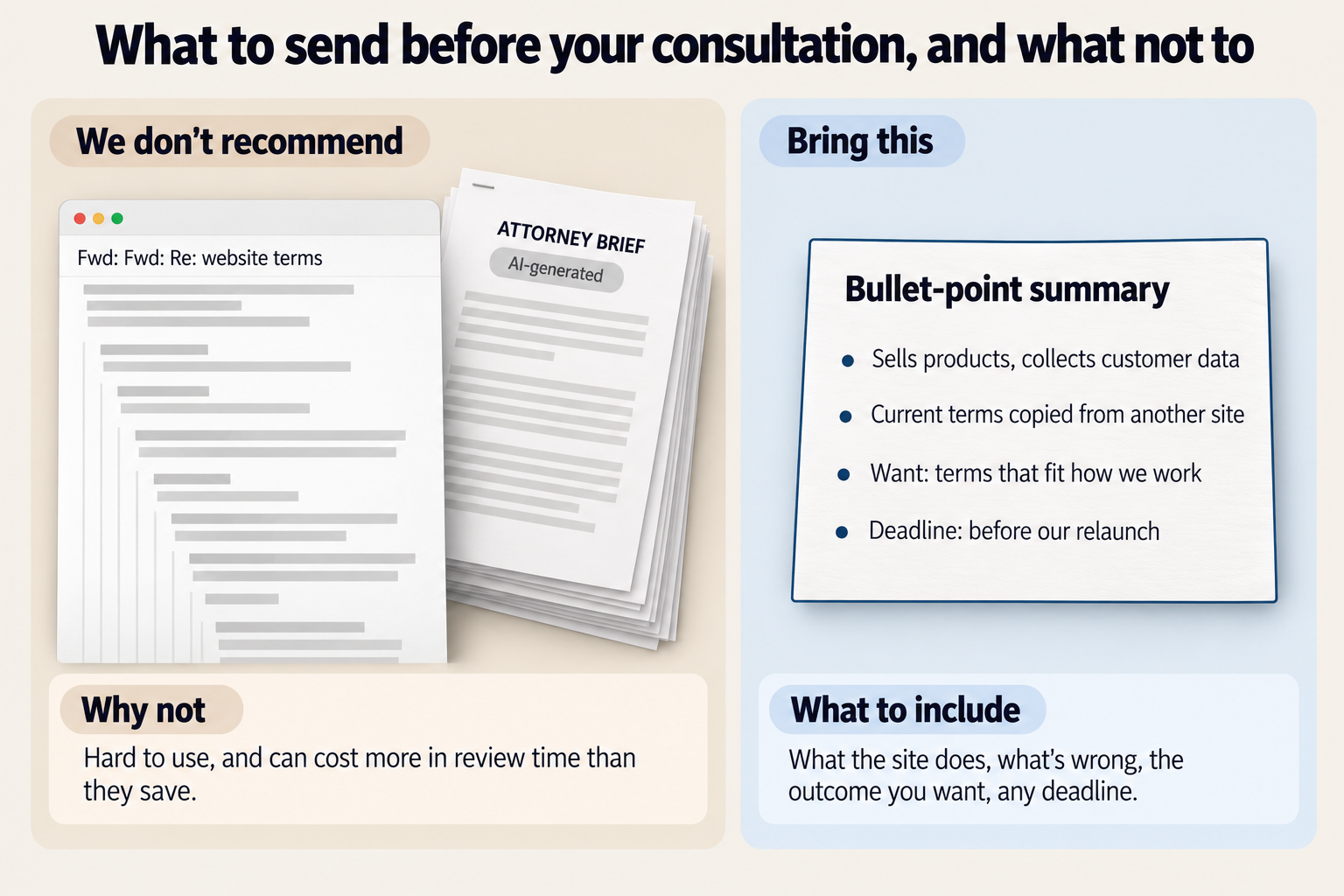 Four short lines about your site do more than a long thread or an AI brief, and take less review time.
Lawyer For Business doesn’t offer a flat fee for drafting website terms. The firm’s flat fees cover entity formation and trademarks only, so this work is billed hourly and quoted by scope.
| Cost | Paid to | Amount | When it applies |
|---|---|---|---|
| Hourly rate | Lawyer For Business | $350 per hour, as of October 1, 2026 | Billed for calls, emails, drafting and follow-up once you’re a client |
| New client consultation | Lawyer For Business | $350, plus a nominal credit card charge, as of October 1, 2026 | A 45-minute session to go over your site and scope the work |
| Copyright agent designation | U.S. Copyright Office | $6, as of October 2026 | If your site lets users post or store their own content and you want the federal safe harbor that comes with designating an agent; renews every three years |
Compare quotes by scope, not just the number. The same hourly rate can mean very different totals depending on how complex your site is and how much of your current terms is usable.
Once you know roughly what the work involves and how it’s billed, the remaining question is who to hire for it, and from where.
Searching for a “technology attorney” or an “internet lawyer” makes sense, since the terms live on a website. What matters more than that label is experience with businesses like yours. Lawyer For Business provides business-focused legal counsel without taking on unrelated practice areas, which is the more useful qualification when the work is drafting a contract for your company, not debugging your site.
Andrea A. Willis is a Florida Bar and New York bar member in good standing.
Lawyer For Business is Buffalo-based and provides virtual legal help for small-business owners across New York. Consultations are fully virtual, by phone or video, and you can handle the entire matter online without setting foot in an office.
The firm drafts customer terms and conditions as part of its New York contract work, alongside privacy and returns policies for businesses getting their site and their paperwork in order at the same time.
The next step is a New York business consultation, where we go over what your site does and scope the work from there.
The information you obtain at this site is not, nor is it intended to be, legal advice. Contacting us does not create an attorney-client relationship. Please do not send any confidential information to us until an attorney-client relationship has been established.