
Two people split a New York LLC 50/50, and nobody ever signed an operating agreement. Now one of you wants out, or wants the other out, and you’re not sure what the law actually gives you to work with.
Here’s the assumption that gets most owners in trouble: that no agreement means either partner can simply leave, or that a judge will step in and order one of you to buy the other out. New York’s default rules work differently.
New York LLC Law § 606 governs this. Absent operating agreement terms that say otherwise, a member, the statute’s word for an LLC owner, may not withdraw from the company before it’s dissolved and wound up. Your partner can’t just walk away, and you can’t force an exit by declaring the partnership over. This is the current default rule. LLCs formed before an earlier version of this statute was amended may follow a slightly different version of it, so it’s worth checking which one applies to your company’s original filing date.
What that leaves is a negotiated deal: you and your partner agree a price and terms, and put the sale of their entire interest in writing. We tell every pair of owners the same thing: if a promise between you matters, put it in writing, because an unwritten understanding is exactly what leaves two partners arguing over what was agreed.
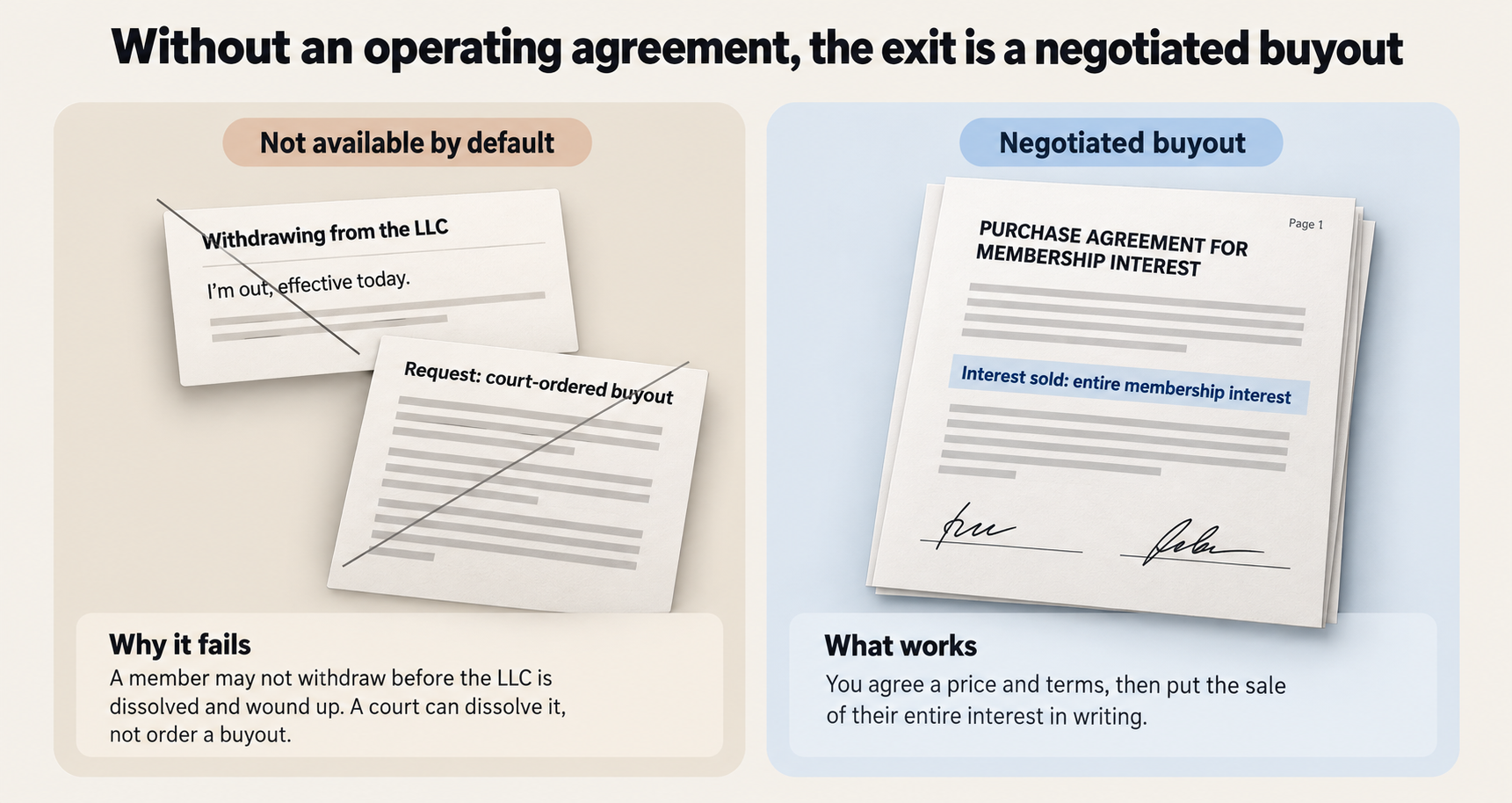 Without an operating agreement, a member can’t simply withdraw and a court can’t order a buyout. The exit is a negotiated sale of the entire interest, in writing.
This guide covers what New York’s default rules give each of you and how a negotiated buyout gets done and documented from start to finish. It also covers what belongs to your CPA rather than your lawyer, and what New York’s courts require if your partner won’t sell at all.
New York LLC Law § 603 governs what happens when you try to sell or transfer your half of the company. Unless your operating agreement says otherwise, here’s the default:
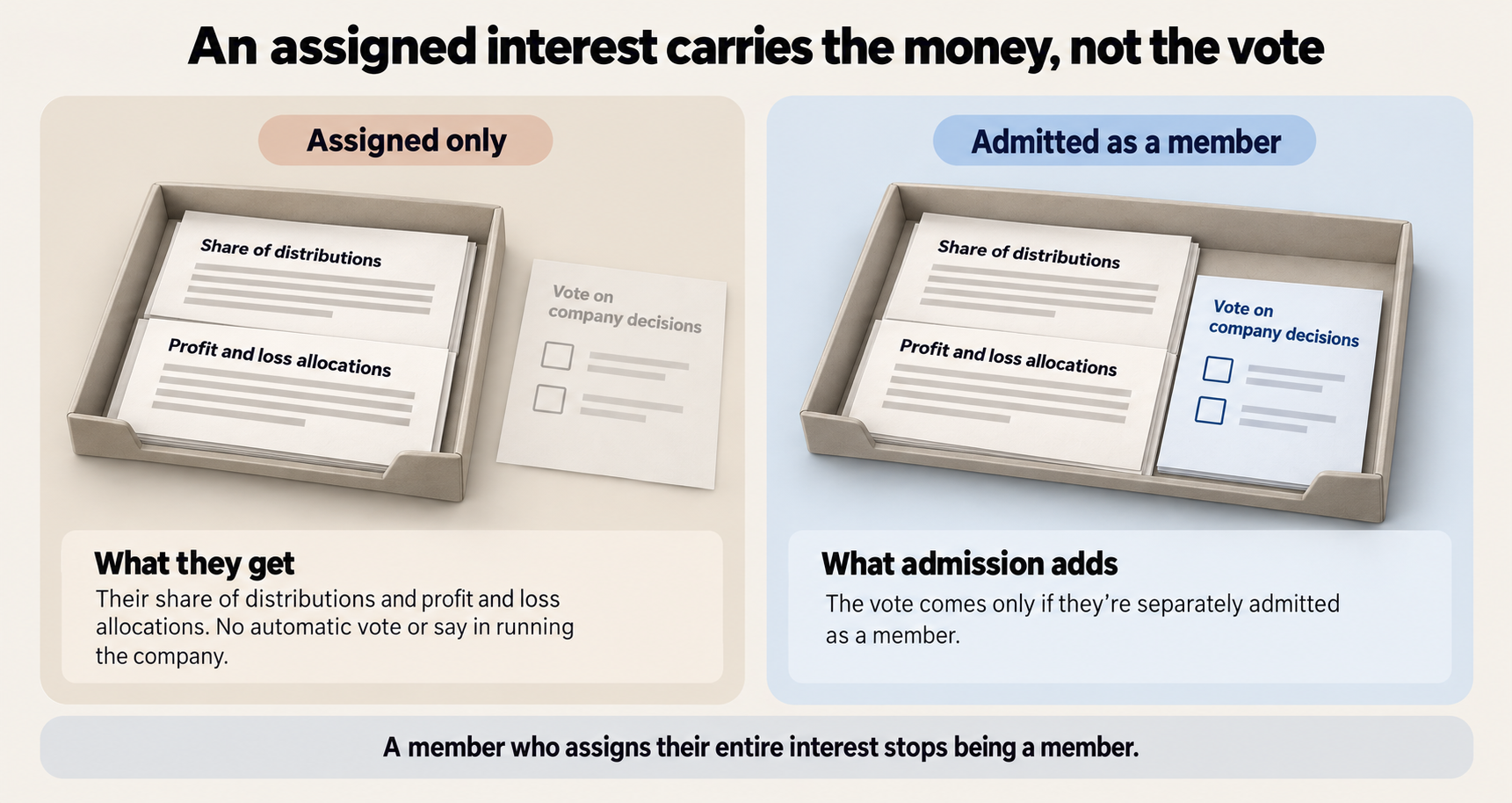 By default, an assigned interest carries the money, not the vote. The vote comes only if the buyer is separately admitted as a member.
That gap, between who gets paid and who gets to run the company, is exactly where a 50/50 buyout can stall. A 50/50 split sounds fair until the two of you disagree, and it’s the one ownership structure where neither partner can outvote the other. We’ve seen that kind of gridlock get bad enough to threaten the company itself. Our recommendation for any two owners splitting a company this way is to agree on clear roles, a decision-making process, and ideally a neutral tie-breaker, before a disagreement forces the question.
None of that tells you how to actually get your partner’s interest into your hands. That’s a process the two of you build yourselves, and it has a reliable order.
Step five is where most of the real risk in a buyout sits, because a verbal agreement on price doesn’t settle any of what comes after it.
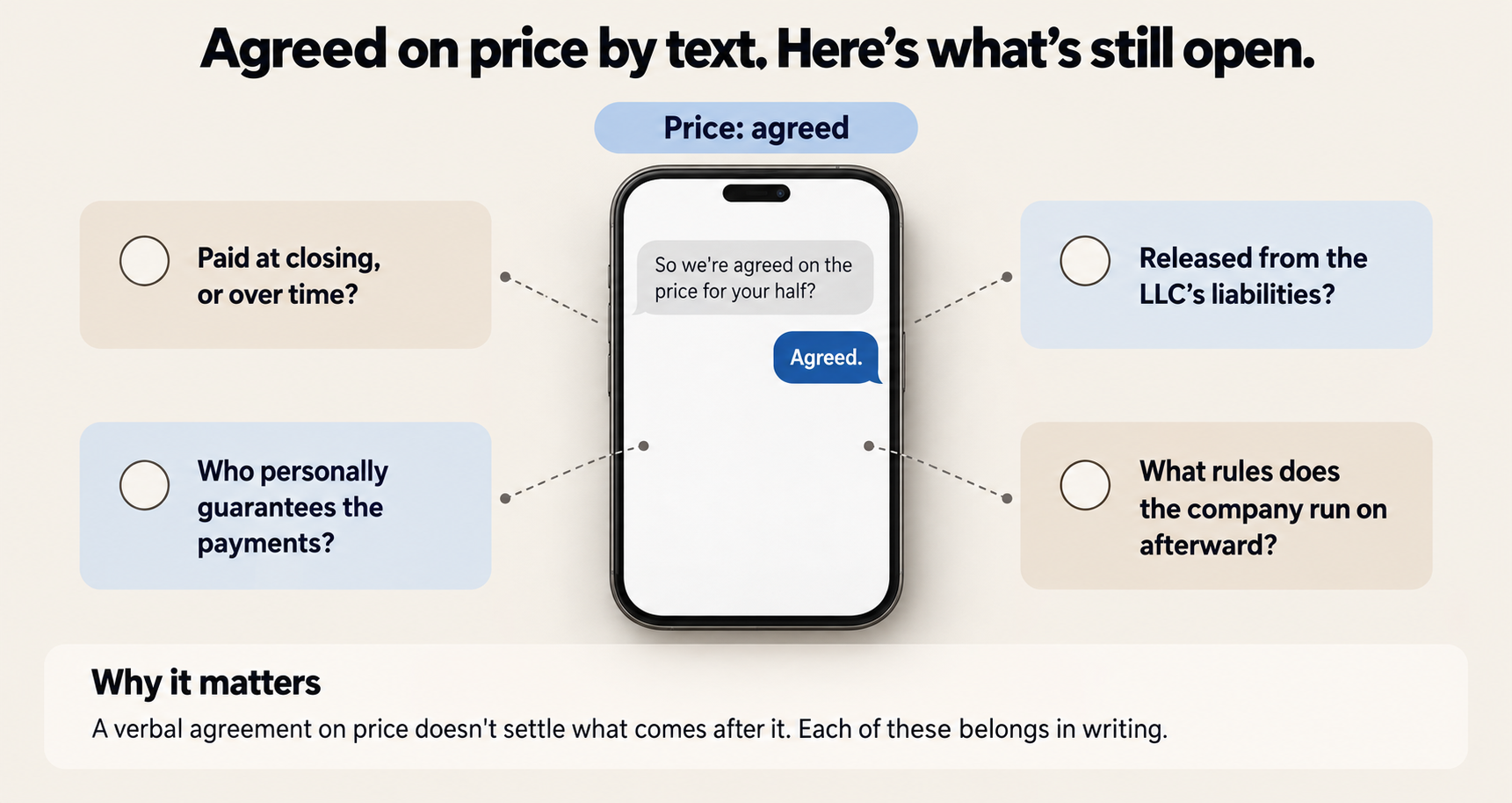 A verbal agreement on price doesn’t settle what comes after it. Each of these belongs in writing.
A New York partner buyout usually runs on a specific set of documents, and each one settles a different question.
| Document or decision | What it settles | Who usually prepares or advises |
|---|---|---|
| Purchase agreement for the membership interest | The price, exactly what’s being sold, and each of you releasing the other from the LLC’s liabilities going forward | Business lawyer |
| Promissory note | The payment schedule, if your partner isn’t paid in full at closing | Business lawyer |
| Personal guaranty | Whether an owner stands behind the payments personally, beyond what the LLC itself owes | Business lawyer |
| Member resolutions | The company’s own formal record approving the sale and the change in ownership | Business lawyer |
| Amended or new operating agreement | The rules the remaining owner, now likely the LLC’s sole member, runs the company under afterward | Business lawyer |
| Tax classification | Whether the LLC’s federal tax treatment changes now that it has one member instead of two | CPA |
That last row matters more than it looks. Under IRS Publication 3402, a domestic LLC with two or more members is taxed as a partnership unless it elects corporate treatment. Once membership drops to one, the LLC becomes disregarded as separate from its owner for federal tax purposes, unless a corporate election is already in place. What that means for your specific filings is a question for your CPA, discussed alongside your lawyer rather than instead of one.
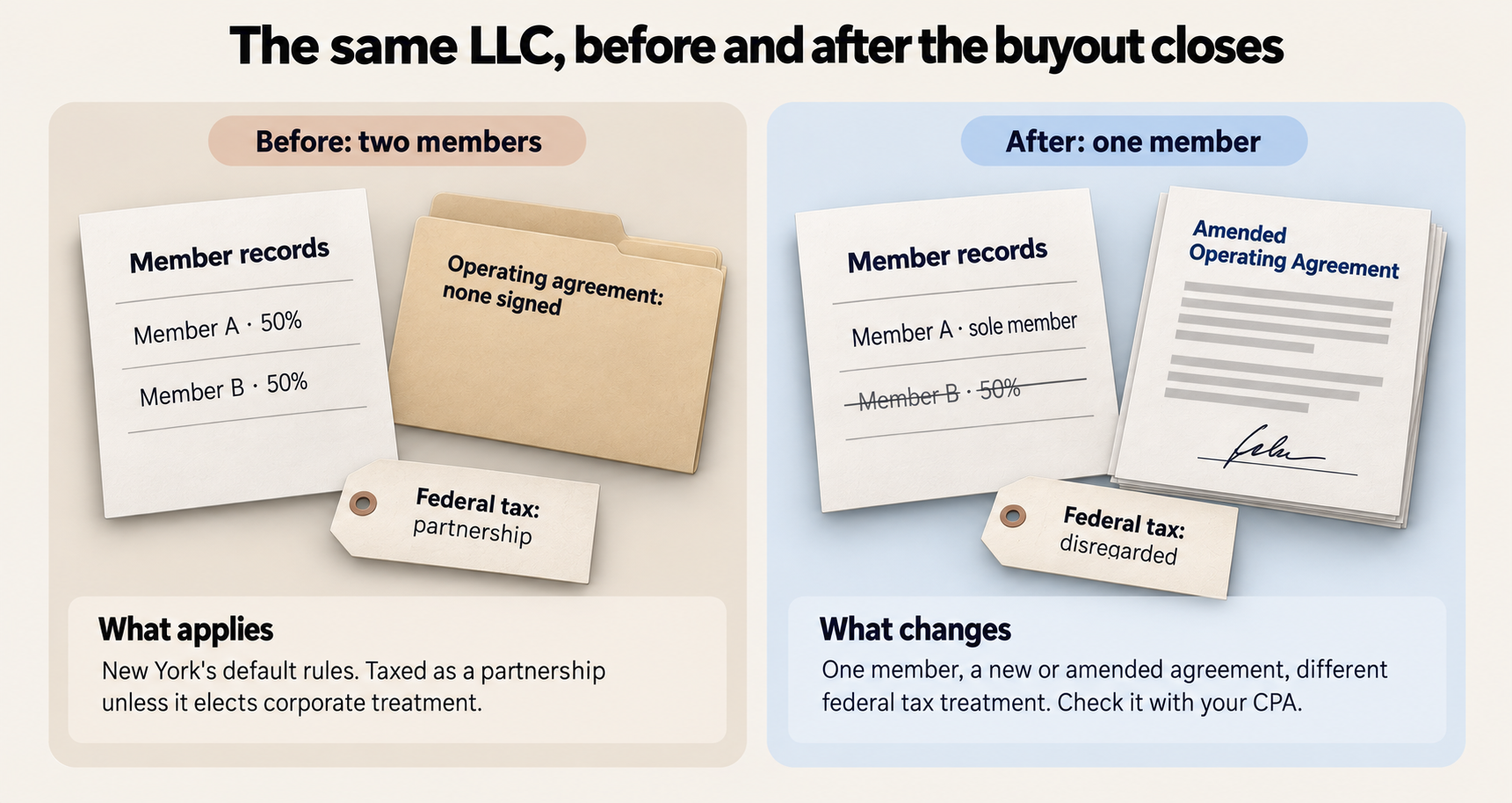 Before the buyout, two members, New York’s default rules, and partnership tax treatment. After it, one member, a new or amended agreement, and different federal tax treatment to check with your CPA.
We draft and update New York operating agreements, including the amended agreement a sole remaining member needs once a buyout closes.
New York gives you two real paths once a partner won’t negotiate: keep working toward a deal, or ask a court to end the LLC entirely – what the statute calls judicial dissolution.
| Path | Who decides | What New York law requires | How we handle it |
|---|---|---|---|
| Negotiated buyout | The two of you | No court filing or statutory standard to meet, just an agreement you put in writing | We draft and negotiate the purchase documents |
| Judicial dissolution under LLC Law § 702 | The New York Supreme Court, in the judicial district where the LLC’s office is located | Dissolution only where it’s “not reasonably practicable to carry on the business” in conformity with the articles of organization or operating agreement; the applicant must then file a certified copy of the court’s order with the Department of State within 30 days | We bring in litigation co-counsel, since a contested case isn’t a transactional matter |
Judicial dissolution ends the company itself. New York’s courts grant it only under the standard quoted above, nothing broader.
If your partner won’t negotiate at all, that usually means the matter has moved from a contract conversation to a dispute. We handle buyouts as business transactions, and when one turns contested, we bring in a team of litigation co-counsel we work with for matters outside business transactional law. We don’t litigate the case ourselves; we make sure the right counsel is handling it alongside us.
Involving a lawyer at that point doesn’t automatically mean the matter heads to court. Many disputes that look headed for litigation still settle once both sides have counsel who can negotiate directly with each other.
Partner buyouts rarely stall over price. They stall because the two owners waited too long to have the conversation at all, and by the time one of you raises it, the trust that would have made it simple is already gone.
Andrea A. Willis, the attorney behind Lawyer For Business, puts it this way:
Some of the worst partnership disputes and LLC lawsuits I see begin with an operating agreement that appeared “good enough” when the company was formed… Many business disputes are entirely predictable years before they happen. I have seen six-figure businesses collapse because a generic AI operating agreement or online template failed to properly address ownership exits, distributions, voting authority, or transfer restrictions… I have seen businesses spend tens of thousands of dollars litigating disputes that could have been prevented with stronger drafting upfront.
That’s the pattern across almost every contested buyout we see: the agreement nobody got around to writing, or the one assembled from a template and never checked. Here’s what we do once you’re ready to negotiate one, or to finish one that’s already underway.
We represent owners on both sides of a New York LLC partner buyout: the one being bought out and the one buying. Partner Buyouts sit on our New York business and sale service list, alongside the related work a buyout actually needs:
Our fees run hourly, as a flat fee for a defined project such as LLC formation or trademark application, or as a retainer, and we give you a transparent estimate at your initial consultation. The whole engagement, documents, calls, and signing, can be handled online, without setting foot in our office.
If your LLC was formed in Florida rather than New York, Andrea is licensed in both states. Our guide to Florida LLC partner buyouts covers that state’s own default rules, which differ from New York’s.
If you’re ready to talk through where your buyout stands, our New York Business Consultation is a 45-minute session for $350, as of October 2026.
Yes. New York LLC Law § 417 requires the members of an LLC to adopt a written operating agreement covering the business, the conduct of its affairs, and the members’ rights, obligations, and duties.
Many owners file the LLC’s formation paperwork online and never take this second step, which is exactly the gap this page addresses. The statute doesn’t attach a specific penalty to skipping it, but without one, the LLC runs on New York’s default rules instead of terms the owners actually chose.
Not directly. New York’s statute lets a member apply to the state supreme court in the judicial district where the LLC’s office is located for dissolution of the company. That dissolution ends the LLC rather than forcing one owner to buy out the other.
Whether a court grants that request depends on the specific facts of the company, and this page makes no prediction about any case.
Many owners form their LLC through an online filing service and don’t realize until later that they also need a properly drafted operating agreement between the members.
If something like that exists only as an unsigned draft, it’s still worth pulling out before you negotiate, since it shows what the two of you once had in mind. We recommend reviewing where things actually stand with a business attorney before you agree on a price.
The information you obtain at this site is not, nor is it intended to be, legal advice. Contacting us does not create an attorney-client relationship. Please do not send any confidential information to us until an attorney-client relationship has been established.
 The Paperwork You Still Need After Filing Your Florida LLC on Sunbiz With a Partner
 Buying a Business in Florida: The 20-Point Legal Due Diligence Checklist Most Business Owners Never Complete
 Top 10 AI Contract Red Flags Businesses Miss
 What Kind of Lawyer Reviews a Franchise Agreement and FDD, and What Does It Cost?